Reality Glitches / EP1
The ER That Had To Evacuate Itself
On February 19, 1994, Gloria Ramirez arrived at Riverside General Hospital in medical crisis. Then staff around her began reporting strange symptoms, collapsing, and evacuating the emergency room. Reality Glitches follows the documented incident, the hazmat response, the DMSO chemistry theory, the pushback, and the uncomfortable space between explanation and proof. Archive of Worlds: https://podcasts.spennington.dev/shows/reality-glitches/episodes/the-er-that-evacuated-itself
Listen now
The ER That Had To Evacuate Itself
External reader
Open the original story reader
The original reader remains available; this Archive of Worlds page preserves the durable index, chapter list, and world context.
Open readerVisual audiobook
Reviewed video chapters
Reviewed video chapters remain available here as a stable visual-audiobook index, with posters and playback links preserved.
Case file / 1
The ER That Had To Evacuate Itself - video case file
Generated Reality Glitches card cut with Steven-clone narration and AOW CTA.
Open MP4Show notes
What this episode covers
- Steven approved the full Reality Glitches review cut before the CTA pass on July 6, 2026.
- The video uses 57 approved generated evidence cards plus one exact-text Archive of Worlds CTA card.
- The narration uses the newest Steven ElevenLabs clone and the chunked pacing workflow developed during the episode audition pass.
- The AOW page preserves audio and video as queueable media, plus source links and visual artifacts.
- YouTube public copy is published on the separate Archive of Worlds channel, not The Synthetic Lens.
Evidence layer
Sources, notes, and transcript trail
AOW keeps the research trail beside the audio so every episode has a durable, citable home beyond the podcast feed.
Research digest
- The incident and staff symptoms are documented in contemporary and later reporting.
- The DMSO to dimethyl sulfone to dimethyl sulfate hypothesis gives the story a possible chemical mechanism, but it remains contested.
- The episode avoids using Gloria Ramirez as a monster or prop and closes on the human cost and uncertainty.
Sources
Attribution trail
- technical case studyOpen source
Medical Mysteries - Toxic Fumes
Lawrence Livermore National Laboratory Forensic Science Center
- journal abstractOpen source
A possible chemical explanation for the events associated with the death of Gloria Ramirez at Riverside General Hospital
PubMed
- ReportingOpen source
Analysis of a Toxic Death
Discover Magazine
- archive reportOpen source
Gloria Ramirez is laid to rest two months after her death
Los Angeles Times
- recent synthesisOpen source
A Woman Walked Into an ER With Trouble Breathing. Then the Entire Hospital Started Collapsing.
Popular Mechanics
Transcript
Readable archive
Read transcript
NARRATOR: At 8:15 on a Saturday night in 1994, an ambulance rolled up to Riverside General Hospital with a 31-year-old woman who could barely breathe.
NARRATOR: Her name was Gloria Ramirez.
NARRATOR: She was awake, frightened, and very sick. She had advanced cervical cancer. Her heart was racing too fast to fill properly between beats. Her blood pressure was dropping.
NARRATOR: The team did what emergency teams do. Oxygen. Monitors. Defibrillator pads. IVs. A blood draw. Everyone in the room was trying to keep one person alive.
NARRATOR: Then the room started failing around her.
NARRATOR: A nurse drew blood and noticed a strange chemical smell. A respiratory therapist smelled it too. A doctor saw unusual particles floating in the sample.
NARRATOR: Someone noticed an oily sheen on Gloria's skin. Others described a garlic-like odor.
NARRATOR: Then one staff member swayed and collapsed. Then another. Then another.
NARRATOR: Within minutes, the emergency room was no longer just treating a patient.
NARRATOR: The emergency room had become the emergency.
NARRATOR: Staff reported lightheadedness, nausea, burning skin, tremors, breathing problems, and fainting.
NARRATOR: People were being wheeled out of the trauma room on gurneys. Replacement staff came in, and some of them began feeling sick too.
NARRATOR: This is the moment where the story sounds like urban legend.
NARRATOR: A woman comes into an ER, and the people trying to save her start dropping.
NARRATOR: But the event was real.
NARRATOR: Riverside declared an internal emergency. Patients were moved out of the ER. Under the orange exterior lights, hospital staff treated people in the parking lot.
NARRATOR: Clothes were bagged. Hazmat crews arrived. The hospital went on diversion, sending new emergency patients somewhere else.
NARRATOR: Inside, a skeleton crew kept working on Gloria.
NARRATOR: They tried to stabilize her. They shocked her heart. They pushed medication.
NARRATOR: At 8:50 p.m., after everything they tried, Gloria Ramirez was pronounced dead.
NARRATOR: That should have been the end of a tragic medical case.
NARRATOR: Instead, it opened one of the strangest forensic investigations in American hospital history.
NARRATOR: In all, accounts commonly say 23 of 37 emergency-room staff reported symptoms. Five were hospitalized overnight.
NARRATOR: One doctor later described a much more serious recovery, including breathing episodes and long-term complications.
NARRATOR: The first suspicion was obvious: toxic gas.
NARRATOR: Maybe sewer gas had entered the room. Maybe some industrial chemical had contaminated the patient, the ambulance, the clothing, the blood sample, or the hospital air.
NARRATOR: Hazmat teams searched for the smoking gun. They tested the emergency room for dangerous compounds.
NARRATOR: They looked for the kind of invisible thing that could knock down trained medical staff in the middle of a resuscitation.
NARRATOR: They did not find it.
NARRATOR: The mystery then moved to the autopsy room. The coroner's team approached Gloria's body as if it might still be dangerous.
NARRATOR: Samples were collected. Air was tested. The body bag and storage container were treated as possible evidence.
NARRATOR: Still, no simple answer appeared.
NARRATOR: And when no obvious chemical was found, the explanation that started to circulate was one of the most loaded phrases in medicine: mass hysteria.
NARRATOR: Today, people might say mass sociogenic illness. The idea is not that staff were lying.
NARRATOR: It is that fear, stress, sensory cues, and a chaotic environment can create real symptoms that spread through a group.
NARRATOR: Emergency rooms are high-pressure places. This was a young dying patient. There were strange smells. People saw colleagues collapse.
NARRATOR: The mind and body can absolutely amplify danger signals.
NARRATOR: But that explanation did not satisfy everyone.
NARRATOR: Because some symptoms looked too severe. Because multiple witnesses described strange physical observations. Because a blood sample reportedly contained unusual particles.
NARRATOR: Because some staff members had recoveries that did not feel like a passing panic event.
NARRATOR: So the coroner's office asked for outside help.
NARRATOR: The case eventually reached scientists at Lawrence Livermore National Laboratory's Forensic Science Center.
NARRATOR: They studied the samples and the timeline, and built a chemical hypothesis around one compound: DMSO.
NARRATOR: Dimethyl sulfoxide.
NARRATOR: DMSO is an industrial solvent, but it has also been used as an alternative pain remedy.
NARRATOR: The Livermore scenario suggested that if Gloria had DMSO in her system, oxygen and emergency treatment conditions might have pushed it along a chemical path.
NARRATOR: DMSO could become dimethyl sulfone, also called DMSO2.
NARRATOR: That part mattered because dimethyl sulfone can crystallize. It gave investigators a possible explanation for the particles people saw in the blood.
NARRATOR: Then came the more dramatic step.
NARRATOR: Under the right conditions, the theory proposed, dimethyl sulfone could be oxidized again into dimethyl sulfate: a highly toxic chemical.
NARRATOR: In other words, the lab's theory was not that Gloria herself was a monster, or a curse, or a walking chemical weapon.
NARRATOR: It was that a chain of chemistry might have happened under rare, awful, hospital-specific conditions.
NARRATOR: DMSO to DMSO2 to dimethyl sulfate. Solvent. Crystal clue. Possible toxic vapor.
NARRATOR: It is elegant as a mystery solution.
NARRATOR: Maybe too elegant.
NARRATOR: The Livermore hypothesis was published in a forensic science journal. It gave the story a mechanism.
NARRATOR: It connected the oily sheen, the garlic-like odor, the particles, and the staff symptoms into one chain.
NARRATOR: But other scientists pushed back.
NARRATOR: Some chemists argued that the proposed transformation into dimethyl sulfate would be very unlikely under those conditions.
NARRATOR: Others questioned whether enough toxic vapor could have formed to affect so many people in the room.
NARRATOR: The mass-sociogenic-illness explanation did not vanish. The chemical theory did not become universal truth.
NARRATOR: That is what makes this case feel like a Reality Glitch.
NARRATOR: Not because reality broke in a supernatural way.
NARRATOR: Because every answer leaves a seam showing.
NARRATOR: If it was only panic, why did the observations line up around smell, sheen, particles, and exposure?
NARRATOR: If it was chemistry, why was the exact chain so difficult to prove?
NARRATOR: If the room was contaminated, why did the hazmat search fail to find the villain?
NARRATOR: If the body released toxic fumes, why did the explanation remain controversial?
NARRATOR: The story became famous under a nickname: the Toxic Lady.
NARRATOR: But that label is the least useful part of the case.
NARRATOR: Gloria Ramirez was a daughter, a wife, a mother, and a person dying of cancer in a hospital room.
NARRATOR: The people around her were trying to save her. The staff who collapsed were not props in a horror story.
NARRATOR: They were medical workers in a real emergency that suddenly became two emergencies at once.
NARRATOR: The mystery is not whether Gloria was toxic.
NARRATOR: The mystery is how a normal ER procedure turned into an evacuation, a hazmat response, a forensic chemistry puzzle, and a debate that still has not completely settled.
NARRATOR: Maybe the answer is chemistry.
NARRATOR: Maybe the answer is stress moving through a room faster than anyone wanted to admit.
NARRATOR: Maybe it is both: a strange odor, a frightening sample, a dying patient, a high-pressure room, and human nervous systems doing what they do when the invisible feels dangerous.
NARRATOR: What we can say is this.
NARRATOR: On February 19, 1994, Riverside's emergency room tried to save one patient.
NARRATOR: Then the room itself became the patient.
NARRATOR: And thirty years later, the case still sits in that uncomfortable space between explanation and proof.
NARRATOR: That is where Reality Glitches lives.
NARRATOR: If you want more strange true stories that refuse to stay explained, like, subscribe, and find the full archive at Archive of Worlds.
Artwork
Episode gallery

Archive of Worlds CTA Card
Exact-text end card appended to the Toxic Lady v2 video candidate.

Toxic Lady v2 Video Contact Sheet
QA contact sheet generated from the actual v2 MP4 after adding the Archive of Worlds CTA end card.
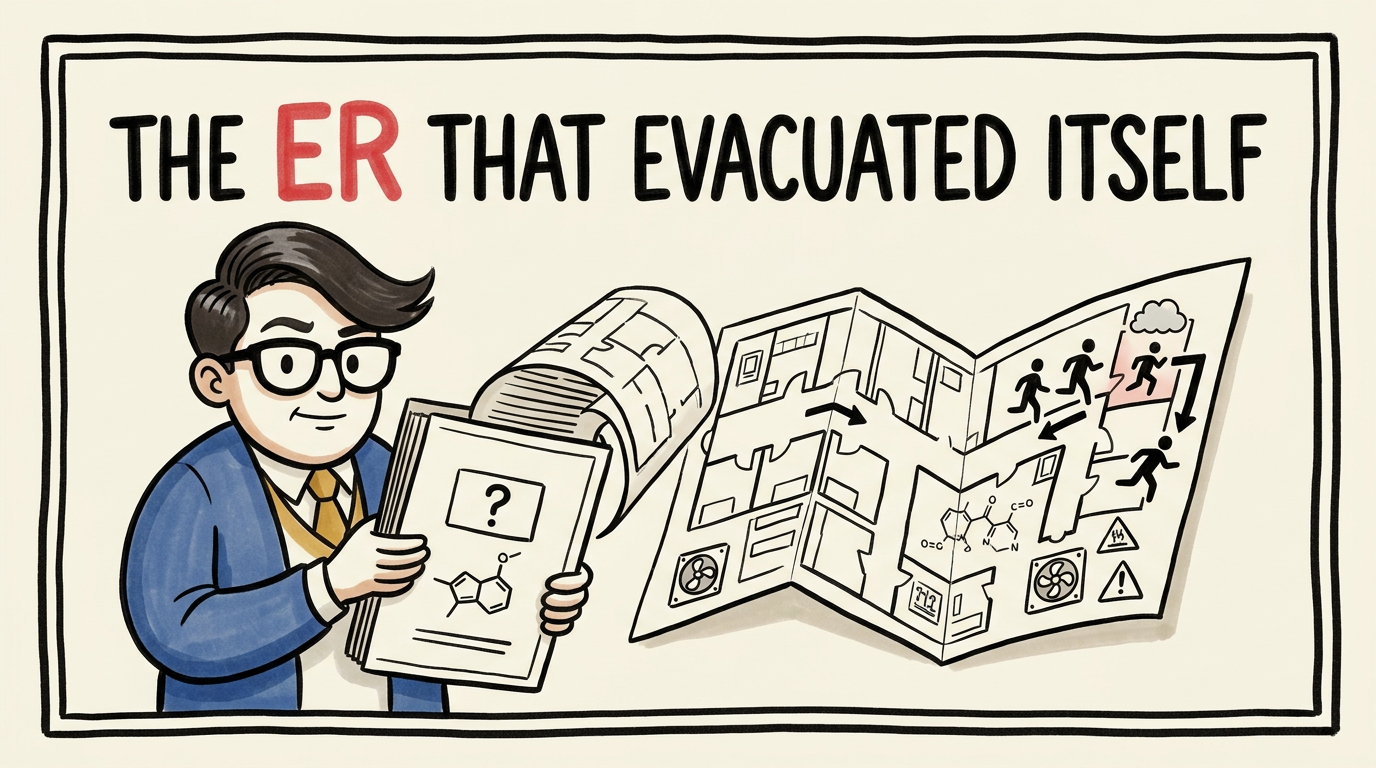
The ER That Evacuated Itself
Final generated title card from the Gloria Ramirez / Riverside ER Reality Glitches case file.