The Synthetic Lens / EP125
Operation Epic Fury: The Ceasefire That Keeps Firing
Operation Epic Fury has moved into a negotiation under fire: a ceasefire framework absorbing continued U.S. and Iranian military action, pressure around the Strait of Hormuz, escalation in Lebanon, and nuclear/diplomatic bargaining. David Carver, James Okafor, Ingrid Halvorsen, Elena Vasquez, and Stan Rogers unpack what is still active, what is only being priced as progress, and why the draft memorandum should not be mistaken for a finished peace. Archive of Worlds: https://podcasts.spennington.dev/shows/the-synthetic-lens/episodes/tsl-ep125-ceasefire-that-keeps-firing
Listen now
Operation Epic Fury: The Ceasefire That Keeps Firing
Show notes
What this episode covers
- Frames Operation Epic Fury as a negotiation under fire rather than a clean postwar settlement.
- Separates the CENTCOM self-defense strike account from the separate Kuwaiti base injury report.
- Explains why Hormuz market moves should be treated as pricing expectations, not proof of diplomatic progress.
- Connects Lebanon escalation to the U.S.-Iran ceasefire framework without treating the fronts as interchangeable.
- Distinguishes uranium and enrichment negotiations from conventional strikes on nuclear-linked infrastructure.
Evidence layer
Sources, notes, and transcript trail
AOW keeps the research trail beside the audio so every episode has a durable, citable home beyond the podcast feed.
Research digest
- CENTCOM described the May 31 strikes as self-defense actions after a U.S. drone, reported as an MQ-1, was shot down over international waters.
- The episode distinguishes that operation from separate reports of minor injuries after an Iranian missile strike toward a Kuwaiti air base.
- Hormuz remains militarized and politically weaponized even when oil markets price in ceasefire-extension hopes.
- Iran is tying U.S.-Iran diplomacy to Lebanon while Israel continues operations against Hezbollah.
- The nuclear issue is split between negotiations over uranium/enrichment constraints and conventional strikes on nuclear-linked infrastructure.
Sources
Attribution trail
- official statementOpen source
May 31 self-defense strike statement
U.S. Central Command
- ReportingOpen source
U.S.-Iran ceasefire and diplomacy live updates
CBS News
- ReportingOpen source
Iran war and Strait of Hormuz context
BBC
- market reportingOpen source
Oil market reaction and ceasefire-extension reporting
CNBC
- ReportingOpen source
Strait of Hormuz violence and shipping-safety context
Al Jazeera
- ReportingOpen source
Israel-Lebanon military updates
ABC News
- ReportingOpen source
Parchin-Taleghan 2 nuclear-linked site report
Jerusalem Post
Transcript
Readable archive
Read transcript
DAVID: The strangest kind of war is the one that keeps insisting it is almost over.
DAVID: Operation Epic Fury began as a U.S.-Israeli campaign against Iran's nuclear and military infrastructure, then widened into missiles, proxies, downed aircraft, and the fight over the Strait of Hormuz.
DAVID: It has not vanished from the headlines because it ended. It has faded because it entered a more confusing phase. There is a ceasefire. There are negotiations. There is a draft memorandum. There are mediators passing edits between Washington and Tehran.
DAVID: And at the same time, there are U.S. strikes on Iranian radar and drone sites, Iranian missile fire toward Kuwait, Israel pushing deeper into southern Lebanon, and the Strait of Hormuz still functioning less like a shipping lane than a geopolitical pressure valve.
DAVID: So today, a catch-up episode. Not a clean turning point. Not a victory lap. A status report on a war stuck between diplomacy and combat. I'm David Carver. This is The Synthetic Lens.
DAVID: James Okafor is with us on the military picture. James, start with the weekend. What did CENTCOM say happened?
JAMES: CENTCOM says U.S. forces conducted what it called self-defense strikes on Iranian radar and drone command-and-control sites in Goruk and on Qeshm Island. The stated trigger was Iran shooting down a U.S. MQ-1 drone that CENTCOM says was operating over international waters.
JAMES: The U.S. account is specific on the target set. Fighter aircraft eliminated Iranian air defenses, a drone ground control station, and two one-way attack drones that CENTCOM said posed clear threats to ships transiting regional waters. CENTCOM also said no American service members were harmed in that specific self-defense operation.
DAVID: And the phrase doing a lot of work there is "self-defense strikes."
JAMES: Yes. Operationally, that phrase is meant to keep the action inside the ceasefire frame. Washington is saying: we are not restarting the war, we are defending assets and shipping against immediate threats. Iran is saying the opposite: that the United States is violating the ceasefire and then laundering those violations through defensive language.
JAMES: Both can be partly true in the way conflict actually works. A ceasefire can reduce the main campaign and still leave forces in contact. If drones, radar sites, air-defense systems, and mine-laying boats are still active near a chokepoint, commanders will keep asking for authority to hit them. The military logic does not stop just because diplomats are editing a document.
DAVID: Iran is also claiming the U.S. keeps violating the ceasefire.
JAMES: Correct. CBS carried comments from Iran's foreign ministry saying the United States had continued to violate the ceasefire, including on Monday. Tehran is also connecting those violations to a broader lack of trust: shifting U.S. positions, Israeli actions in Lebanon, and disagreement over what any regional pause actually covers.
JAMES: The important point is that the ceasefire is not just one line on a map. It touches Hormuz, southern Iran, Lebanon, Israel, U.S. bases in the Gulf, and the nuclear file. That makes it fragile by design. Every actor can say the other side broke it somewhere.
DAVID: Separately, we also have the Kuwaiti base incident.
JAMES: CBS reported that four U.S. service members and three contractors suffered minor injuries after an Iranian ballistic missile strike toward a Kuwaiti air base last week. The missile was intercepted by Kuwaiti forces, and the seven injured people returned to duty within 24 hours.
JAMES: That is a small casualty report compared with the scale of the war, but it matters. It shows that Iran still has ways to impose risk on U.S. personnel without necessarily launching a full strategic escalation. Ballistic missiles, drones, proxy fire, maritime harassment. Tehran is keeping multiple pressure channels open.
DAVID: Ingrid Halvorsen, bring in the Strait of Hormuz. We keep saying it is central. What is the current state?
INGRID: The honest answer is: not normal. Not fully closed in a simple way, either. The Strait is militarized, constrained, and politically weaponized.
INGRID: CNBC reported that oil prices turned lower after U.S. and Iranian negotiators appeared to be moving toward a possible 60-day ceasefire extension and memorandum of understanding. Brent closed around ninety-three dollars and seventy-one cents in that report, with West Texas Intermediate around eighty-eight dollars and ninety cents. That price move tells you markets are desperate to price in a deal.
DAVID: But the market is not the waterway.
INGRID: Exactly. The same CNBC report makes clear the dispute is not solved. Iran's state television claimed a draft would open the Strait to prewar levels of commercial traffic, with Iran and Oman managing traffic. The White House dismissed that as a fabrication. Trump said no nation would control shipping through the Strait.
INGRID: That is the argument in miniature. Iran wants to convert disruption into recognized leverage. The United States wants reopening without legitimizing Iranian control. Gulf states want traffic restored without becoming the battlefield. Shipping companies want something more reliable than a politician saying the route is safe.
DAVID: Earlier in May, Al Jazeera had oil much higher.
INGRID: Yes. Al Jazeera reported Brent near one hundred fourteen dollars after violence flared in the Strait. It also reported hesitation from shipping companies even after the U.S. announced efforts to guide commercial vessels through. The International Transport Workers' Federation warned that vessels should not be treated as having a green light without guarantees of safety. The IMO was cited as saying thousands of seafarers were stranded on vessels in the area.
INGRID: That is why the economic story is not only the oil price ticker. It is insurance, crew safety, mine risk, delayed cargo, rerouting, and the credibility of any escort operation. Even if a memorandum is signed tomorrow, traffic does not instantly return to normal. Markets can move in minutes. Maritime confidence rebuilds more slowly.
DAVID: So if someone says, "They are close to a deal, oil is down, this is ending," your answer is?
INGRID: My answer is: maybe, but that is not a settlement. It is a repricing of risk. The underlying risk remains until ships can move, insurers can price the route normally, and both sides stop using Hormuz as leverage.
DAVID: Elena Vasquez, Iran is tying this to Lebanon. Why?
ELENA: Because Lebanon is where the regional war refuses to stay in the margins. CBS reported Iran's foreign ministry saying a ceasefire in Lebanon is an essential condition for any deal aimed at ending the war. That is not an abstract demand. Israel is expanding operations against Hezbollah in southern Lebanon.
ELENA: ABC reported that Israeli forces advanced north of the Litani River and secured Beaufort Ridge, near Nabatieh. CBS also reported Israel's capture of Beaufort Castle and Netanyahu calling it a dramatic shift. Israeli officials are saying the campaign is not over. Lebanese officials are accusing Israel of aggression and collective punishment. Hezbollah is still fighting.
DAVID: So the U.S.-Iran track cannot be separated cleanly from Israel-Hezbollah.
ELENA: Not cleanly. Washington may want to negotiate Hormuz and uranium as if those are the two hard boxes. Tehran is saying: no, the regional battlefield is part of the deal. Israel is saying through action: Hezbollah cannot be allowed to use a ceasefire to recover or reposition.
ELENA: That creates a triangle. The U.S. wants de-escalation in Hormuz because oil and shipping matter. Iran wants sanctions relief and recognition of leverage. Israel wants operational freedom in Lebanon. Those goals are not impossible to reconcile, but they are not aligned.
DAVID: There is also a human cost here that can get buried under the shipping maps.
ELENA: It is already being buried. Southern Lebanon is again being emptied, hit, and argued over as strategic terrain. People hear "Beaufort Ridge" or "north of the Litani" and it sounds like a board game. It means villages, evacuation orders, infrastructure loss, families moving again. And for Hezbollah, civilian suffering becomes part of the mobilization narrative. For Israel, every rocket or cross-border attack becomes justification for pushing farther. That is how a ceasefire becomes a pause on paper and a campaign on the ground.
DAVID: James, I want to narrow one nuclear point. The draft deal reportedly involves highly enriched uranium. But we have also had strikes on nuclear-linked sites over the course of this war. How should listeners separate those?
JAMES: Carefully. The uranium issue is about stockpiles, enrichment levels, verification, and whether material is removed, diluted, or frozen under some interim arrangement. CBS reported that Trump's edits to the possible memorandum focused partly on the removal of highly enriched uranium.
JAMES: The strike history is related but not identical. For example, the Jerusalem Post reported in March that Israel struck Parchin-Taleghan 2, a nuclear-linked explosives site associated with weaponization work. That is not the same thing as the current June negotiation over uranium stockpiles. One is about physical infrastructure and suspected weaponization pathways. The other is about nuclear material and diplomatic constraints.
JAMES: That distinction matters because "nuclear" becomes a very blurry word in public debate. There has been no nuclear weapon use. These are conventional strikes on nuclear-linked facilities, and negotiations over enrichment and stockpiles.
DAVID: Stan Rogers, come into the Washington side. What is Trump trying to do here?
STAN: He is trying to keep maximum pressure and maximum flexibility at the same time, which is harder than it sounds. CBS reported that Trump made edits to the U.S.-Iran memorandum of understanding, with the big issues being Hormuz and highly enriched uranium. The broad draft reportedly includes a 60-day cessation of violence, reopening the Strait, a framework for nuclear talks, and possible sanctions relief or access to frozen assets depending on progress.
STAN: That lets Trump say he is not rushing into a bad deal. It also lets him say diplomacy is alive. But the facts keep interrupting the message. CENTCOM is announcing strikes. Iran is accusing the U.S. of violations. Israel is moving in Lebanon. And Trump is posting that critics should stop "chirping" while he negotiates.
DAVID: Is that just political theater, or does it affect the deal?
STAN: It affects the deal because every side is watching his room for weakness. Congressional critics are asking whether the war has authorization, cost discipline, or an end state. Hawks want him to keep hitting Iran. Markets want him to calm oil. Regional partners want stability. Iran wants to know whether he can actually deliver sanctions relief if he signs something.
STAN: So the domestic politics are not separate from the diplomacy. They shape the credibility of the offer. If Tehran thinks Trump needs a deal because oil prices are politically dangerous, it holds out. If Washington thinks Iran needs sanctions relief more than it needs Hormuz leverage, it holds out. That is why "close to a deal" can stay close for a long time.
DAVID: So when Trump says they are close, listeners should hear progress, but not completion.
STAN: Exactly. Close means the parties are still bargaining inside the same document. It does not mean the hard parts are settled, or that the military pressure has stopped.
DAVID: Ingrid, the phrase that keeps coming up is "60-day cessation of violence." Is that meaningful?
INGRID: It can be. Sixty days can lower oil risk, create inspection and verification steps, and give shipping operators a planning window. But it can also become a postponement mechanism. The hard issues are not solved by the number sixty. They are solved by who controls the Strait, what happens to enriched uranium, what sanctions relief is front-loaded, and whether Israel and Hezbollah are included in a way that holds.
INGRID: A temporary freeze is valuable only if it reduces the incentives to keep testing the edges. Right now, the edges are where the war lives.
DAVID: James, what should we watch next?
JAMES: Four things. First, whether Iran stops threatening or targeting U.S. drones and ships near the Strait. Second, whether U.S. strikes remain limited to immediate-threat targets or expand again into a broader campaign. Third, whether Israel pauses or deepens operations in Lebanon. Fourth, whether any draft agreement includes an enforceable mechanism for Hormuz: mine clearance, escort rules, traffic monitoring, and who verifies compliance.
JAMES: If those pieces move together, the ceasefire becomes more real. If they move separately, the ceasefire remains a label over a live conflict.
DAVID: Elena, what is the regional risk if this drags on?
ELENA: Normalization of emergency. That is the risk. Everyone adapts to a partially closed Strait, recurring strikes, Israeli operations in Lebanon, Iranian retaliation, and civilians displaced as a background condition. Once that becomes normal, it is easier for leaders to keep taking tactical actions that make strategic peace harder.
ELENA: And there is a second risk: each actor starts believing time is on its side. Israel may believe more pressure weakens Hezbollah. Iran may believe shipping leverage forces sanctions relief. Trump may believe the threat of more strikes gets a better deal. Those beliefs cannot all be right.
DAVID: Stan, last question. Is there enough here for a full episode?
STAN: Absolutely. But I would not sell it as "the war is back." It never left. The better story is that the war has changed shape. It is now a negotiation under fire.
DAVID: A negotiation under fire. That is the cleanest description.
DAVID: Operation Epic Fury is no longer the first-night shock of coordinated strikes, or the early drama of downed aircraft and emergency rescues, or the obvious market panic of a newly militarized Strait. It is something more grinding: a ceasefire framework absorbing small acts of war, one after another, while diplomats try to turn pressure into terms.
DAVID: The next question is not whether the parties can announce a pause. They already have versions of that. The question is whether any of them can stop using violence to improve their position inside the pause.
DAVID: For The Synthetic Lens, I'm David Carver.
Artwork
Episode gallery
Operation Epic Fury: The Ceasefire That Keeps Firing
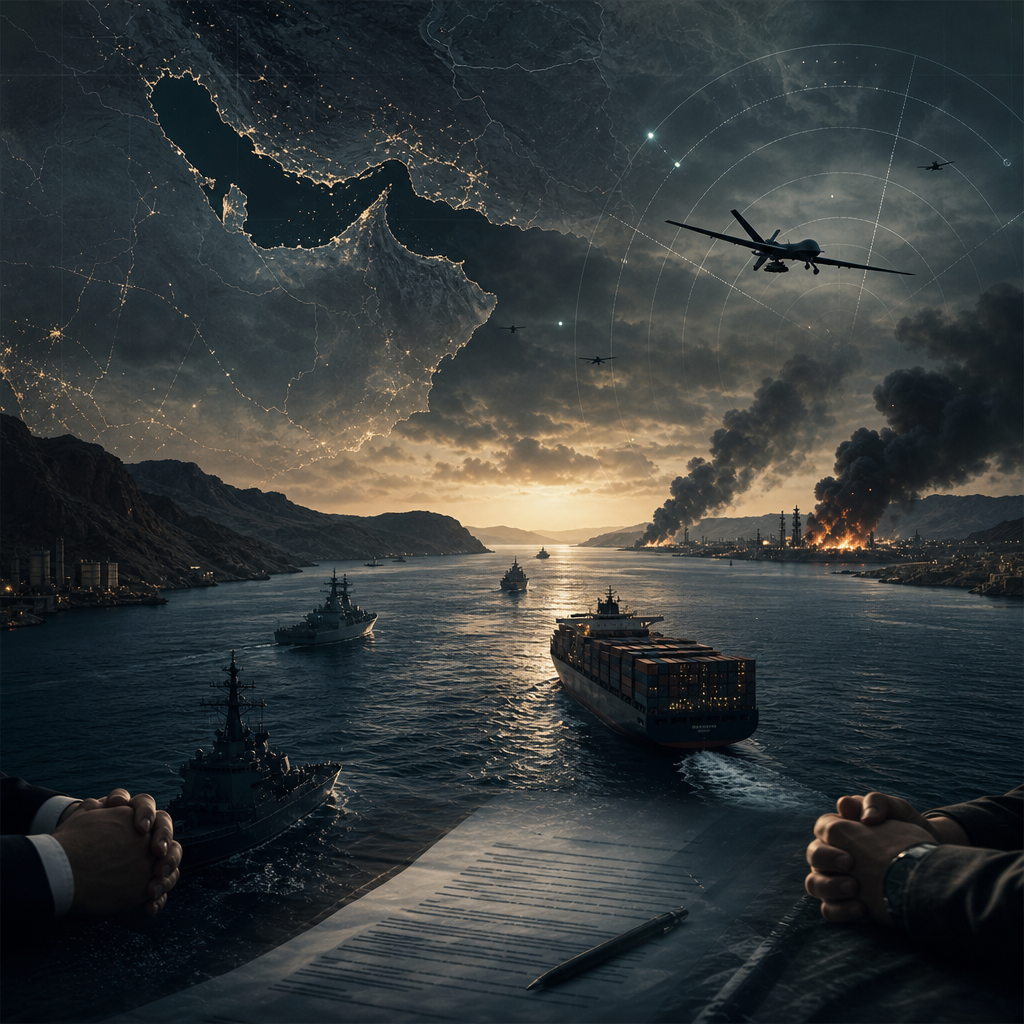
A tense editorial Gulf shipping-lane scene for an episode about ceasefire diplomacy under continuing military pressure.
Related
Continue the thread
EP105 / May 11, 2026
Iran Rejected the Deal. China May Hold the Real Leverage.
The Hormuz story moves from naval incident to endgame diplomacy, with China’s leverage over Iranian oil becoming central to the next phase.
EP101 / May 7, 2026
Hormuz Under Fire
A careful read on the Strait of Hormuz clash, competing official claims, energy risk, and ceasefire pressure.

EP96 / May 5, 2026
TSL Special: Project Freedom and the Strait of Hormuz
A briefing on Project Freedom, the Strait of Hormuz, ceasefire pressure, and energy-market risk.