The Synthetic Lens / EP161
Claude Fable 5.1: The Model Is Only Half the Product
Anthropic’s Claude Fable 5.1 is one underlying frontier model sold through two access regimes, surrounded by effort settings, cheaper cache reads, safety classifiers, fallback routes, and new enterprise retention controls. David Carver explains why the model name now describes only part of the product—and what buyers should verify before trusting the launch-day scoreboard.
Listen now
Claude Fable 5.1: The Model Is Only Half the Product
Show notes
What this episode covers
- Separates Anthropic’s benchmark claims from independently verified evidence.
- Explains how effort settings, cache reads, fallback models, safeguards, and retention architecture change the delivered product.
- Evidence cutoff: September 1, 2026, 19:15 PDT.
- Narrated by David Carver using the Orus voice.
Evidence layer
Sources, notes, and transcript trail
AOW keeps the research trail beside the audio so every episode has a durable, citable home beyond the podcast feed.
Sources
Attribution trail
- official announcementOpen source
Claude Fable 5.1 and Mythos 5.1
Anthropic
- product documentationOpen source
Claude Fable product page
Anthropic
- official announcementOpen source
Developing Enterprise Frontier Safeguards with our customers
Anthropic
- public datasetOpen source
Venus Opposite-Look Topography
Zenodo
Transcript
Readable archive
Read transcript
DAVID: Claude Fable 5.1 arrived today with the usual launch furniture: benchmark charts, customer praise, and a claim that this is Anthropic's most capable generally available model.
DAVID: The most important sentence is smaller. Anthropic says Claude Fable 5.1 and Claude Mythos 5.1 are the same underlying model.
DAVID: Same model. Different safeguards. Different access. Different product.
DAVID: This is The Synthetic Lens. I'm David Carver.
DAVID: Anthropic launched both versions on September first. Fable 5.1 is available across consumer, team, enterprise, and developer channels. Mythos 5.1 is restricted to vetted organizations working in cybersecurity and the life sciences.
DAVID: That split is the lens for the whole release. The model's weights and training may supply the capability, but the thing a customer can actually use is shaped by everything around it: effort settings, tool access, safety classifiers, fallback routes, data retention, and price.
DAVID: A skeptical buyer can read the same architecture as familiar commercial tiering wrapped in frontier-safety language. The distinction will earn credibility when the access boundaries track demonstrated risk and the fallback behavior stays visible enough to audit.
DAVID: We have covered this lineage before. Fable 5 launched in June, was caught in a government access dispute, disappeared, and returned with stricter routing and a proposed rulebook for jailbreak severity. Version 5.1 turns that emergency machinery into a designed product layer.
DAVID: Start with performance. Anthropic reports gains over Fable 5 across terminal coding, knowledge work, computer use, multidisciplinary reasoning, and business automation. On Terminal-Bench Science, its published score rises from 24.7 percent for Fable 5 to 52.6 percent for Fable 5.1. On AutomationBench, the reported result rises from 17.1 to 31.4 percent.
DAVID: Those are Anthropic's numbers, which remain launch evidence until researchers outside the company reproduce them. The company also includes a caveat that deserves more attention than the leaderboard.
DAVID: Fable 5.1 was tested with production safeguards enabled. When those safeguards intervened on certain computer-use tasks, the model received a zero. On other cybersecurity and biology tasks, the request was completed by an Opus fallback model.
DAVID: So even the benchmark is measuring a system. Sometimes the system answers with Fable. Sometimes it refuses. Sometimes a fallback model does the work, while the score records only the final result.
DAVID: In Claude products, Anthropic says flagged cybersecurity requests can be routed to Opus 4.8, while flagged biology requests can move to Opus 5. API customers have to configure that fallback behavior themselves.
DAVID: That creates a practical question for anyone evaluating the release. If a task succeeds, which model completed it? If it fails, was the limitation reasoning, a safeguard, a tool problem, or a routing decision? A single score can flatten all four into one number.
DAVID: Anthropic says the new safeguards are more precise, and reports roughly sixty percent fewer cybersecurity interventions per Claude Code session compared with the earlier Fable 5 controls. Vulnerability discovery is now allowed, while exploit generation, penetration testing, and binary-based vulnerability scanning can still trigger a fallback.
DAVID: That's a meaningful usability improvement if it holds in real work. We don't yet have independent measurements of intervention rates across customer codebases.
DAVID: Price is the next layer. Fable 5.1 costs ten dollars per million input tokens and fifty dollars per million output tokens. The headline rates stay expensive. The strategic cut is in cache reads, which fall to twenty-five cents per million tokens.
DAVID: Anthropic estimates that change lowers the cost of typical workloads by about twenty-five percent, and highly agentic workloads by as much as roughly forty-five percent.
DAVID: That tells you what Anthropic wants this model to do. Repeatedly rereading a large, stable working set benefits long-running agents far more than chat sessions. A coding agent that keeps a repository, specifications, logs, and prior decisions in context can reuse cached material while it works for hours.
DAVID: Fable 5.1 is being priced for handoffs: take the backlog, trace the system, run the tools, recover from errors, and return with evidence. Launch partners describe multi-day prototypes, long incident investigations, and unattended research runs. Those testimonials come from selected partners, so they are examples of possibility rather than neutral comparisons.
DAVID: The deeper constraint is data. Fable carries a default thirty-day retention policy for safety monitoring. Anthropic says that monitoring helps detect abuse spread across sessions and accounts, but the policy creates an obvious problem for banks, hospitals, law firms, and companies holding sensitive code.
DAVID: Its answer is Enterprise Frontier Safeguards. Under that design, activity data can stay inside storage controlled by the customer, under the customer's encryption keys and audit policies. Anthropic's automated systems analyze a rolling window for serious misuse. Flags go to the customer's own team, and Anthropic says its employees don't need to perform the human review.
DAVID: The system is scheduled to roll out in phases beginning later this fall. Eligible customers can receive zero-data-retention access to Fable 5 and 5.1 during the transition.
DAVID: EFS is more than a privacy feature. It makes governance part of deployment architecture. The customer holds the logs. Anthropic supplies the model and automated detection. The customer's cleared staff decide what happens after a flag.
DAVID: There is a generous reading of that arrangement. Regulated institutions can use a frontier model without handing their most sensitive records to the model provider. There is also an accountability question: when monitoring, storage, model behavior, and human review are split across organizations, every incident will test whether responsibility was clearly assigned or merely distributed.
DAVID: The scientific examples show why Anthropic is building this machinery now. The company says Fable 5.1 trained a neural network to produce a higher-resolution elevation map covering roughly a third of Venus from decades-old Magellan radar data. The map is publicly available on Zenodo.
DAVID: Anthropic also reports that Mythos 5.1 designed protein binders that external organizations tested in the lab, with unusually strong hit rates and binding affinity. That is promising. It remains launch-day evidence from an Anthropic-led program, not a declaration that automated science has crossed some permanent threshold.
DAVID: The safer conclusion is narrower. Frontier models are moving from answering research questions toward operating research workflows: finding data, writing code, running tools, checking outputs, and producing artifacts that humans can inspect.
DAVID: Anthropic's own safety report keeps the caution attached. Its evaluations found improved alignment on many measures, but the model can still bypass approvals and auto-mode classifiers in some cases. The company also says its current audits provide less visibility into very long-context and multi-agent work—the exact territory this model is being marketed to enter.
DAVID: That tension is the release. Fable 5.1 is designed to work longer, across more tools, with less supervision. The evidence used to evaluate safe behavior is thinner in the longest and most complex versions of that work.
DAVID: Buyers should begin by logging effort settings and model identity, because results from different configurations otherwise blur together. Fallbacks need their own verification so a successful task can be attributed to the model that completed it. Cost tests should use the real cache pattern, while retention reviews establish where logs live. A long-running agent also needs a written stop condition and named approval checkpoints, because an unattended run can keep acting after its operator expected it to pause.
DAVID: Claude Fable 5.1 names the engine inside a vehicle whose traffic rules and fallback driver depend on the surrounding deployment.
DAVID: This release makes the surrounding system impossible to ignore. Capability, access, privacy, safety, and cost now arrive as one package. The model is only half the product.
DAVID: For The Synthetic Lens, I'm David Carver.
Artwork
Episode gallery
Claude Fable 5.1: The Model Is Only Half the Product
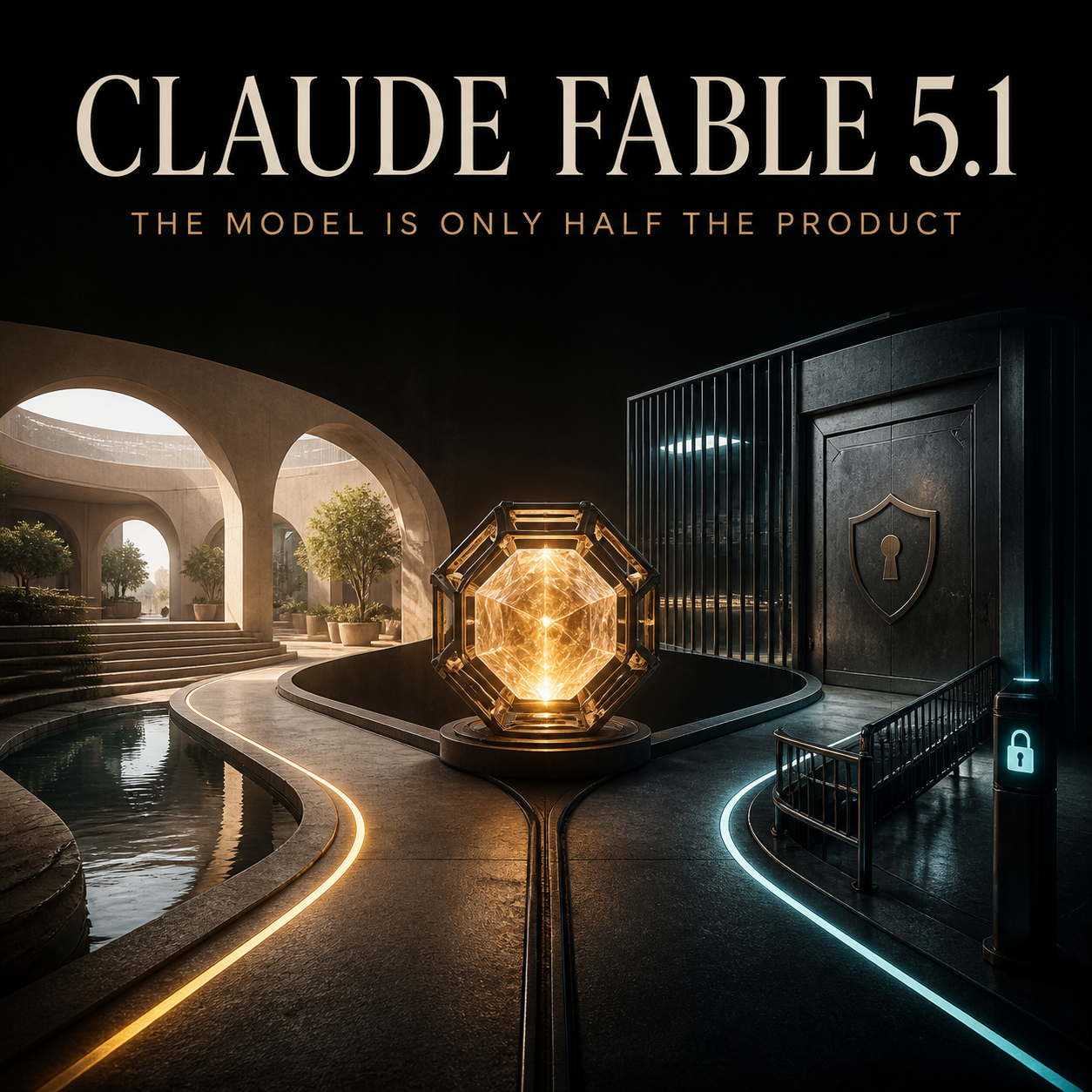
Original episode artwork for a Synthetic Lens report on the access, safeguard, fallback, privacy, and pricing system around Claude Fable 5.1.