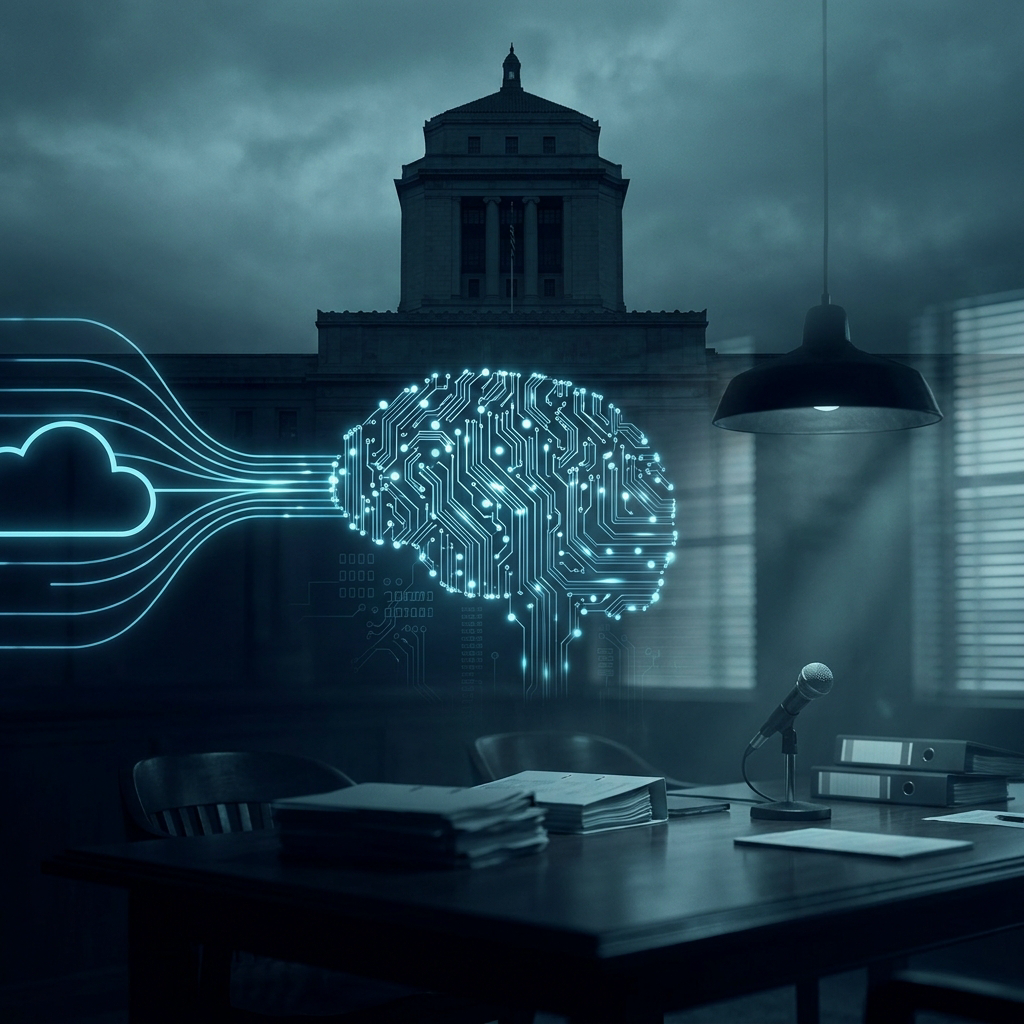
The Synthetic Lens / EP106
TSL Special: Musk v. OpenAI - Nadella Takes the Stand
A short trial-watch special on Satya Nadella’s testimony in Musk v. OpenAI, Microsoft’s commercial role in OpenAI’s rise, and the new docket fight over the 2025 public-benefit-corporation conversion and Bret Taylor testimony scope. The episode is careful about the record: no May 11 transcript, minute sheet, or ruling was public at production time.
Listen now
TSL Special: Musk v. OpenAI - Nadella Takes the Stand
Show notes
What this episode covers
- Centers new Monday testimony from Microsoft CEO Satya Nadella as reported by CNBC.
- Separates CNBC’s courtroom report from primary docket filings and explicitly notes no public May 11 transcript or minute sheet was available.
- Explains the unresolved Docs. 529-531 fight over the October 2025 PBC conversion and attorney-general evidence.
- Frames Doc. 532/533 as a proposed scope for Bret Taylor testimony, not a court finding.
Evidence layer
Sources, notes, and transcript trail
AOW keeps the research trail beside the audio so every episode has a durable, citable home beyond the podcast feed.
Research digest
- CNBC reported Nadella testified Musk never raised concerns to him that Microsoft investments violated special terms or commitments.
- CNBC reported Michael Wetter deposition testimony that Microsoft recognized approximately $9.5B in revenue to date through the OpenAI partnership.
- Docs. 529-531 show an unresolved fight over whether Musk can use the October 2025 PBC conversion as a liability basis and whether OpenAI can discuss AG non-objection evidence.
- Docs. 532-533 preview OpenAI/Microsoft request to permit limited Bret Taylor testimony about the 2023 special committee review.
Sources
Attribution trail
- courtroom reportingOpen source
OpenAI trial: Nadella says Musk never raised concerns to him about Microsoft investment
CNBC
- live update/contextOpen source
Musk v. Altman live updates: Microsoft CEO to testify as week 3 begins
ABC7/KGO
- context/reportingOpen source
Microsoft boss to testify on his role in OpenAI’s founding
AFP via The Star
- witness guide/contextOpen source
The Musk-Altman trial is in the final stretch. These big questions still remain.
Business Insider
Transcript
Readable archive
Read transcript
DAVID: Good afternoon. This is The Synthetic Lens. I'm David Carver. This is a Musk versus OpenAI trial-watch special from Oakland. First, the evidence note. At our one p.m. Pacific check, we again searched the official Northern District of California case page, Judge Yvonne Gonzalez Rogers' calendar, CourtListener and RECAP surfaces, DocketAlarm, PACER-adjacent public pages, GovInfo, and targeted searches for transcripts, minute entries, exhibits, orders, rulings, testimony, and witness names. We found no May eleventh trial sheet, no public trial transcript, no Doc. 534 or later, and no court ruling yet on the weekend trial briefs. So this is not a transcript episode. The new courtroom reporting comes primarily from CNBC's Ashley Capoot and Jordan Novet, paired with the primary docket filings we captured this morning. Marcus Chen is here on Microsoft and the AI money machine. Stan Rogers is here for the legal guardrails.
MARCUS: And today's new fact is simple but important: Satya Nadella finally took the stand. According to CNBC, the Microsoft CEO testified for several hours Monday and has already concluded his testimony. That matters because Microsoft has been the commercial engine sitting behind much of this trial — the 2019 billion-dollar investment, the later multibillion-dollar commitments, the cloud infrastructure, and the 2023 crisis when Sam Altman was fired and then reinstated.
STAN: The careful version is: CNBC reports that Nadella testified Elon Musk never contacted him with concerns that Microsoft's investments in OpenAI violated special terms or commitments. That's a defense-friendly point. Musk has argued that Microsoft's money helped pull OpenAI away from its charitable mission. Nadella's reported answer says: if Musk believed Microsoft's investment violated a promise, he did not raise that concern with Microsoft's CEO.
DAVID: Marcus, why is that more than a courtroom sound bite?
MARCUS: Because it hits the timing problem in Musk's story. Musk says Microsoft's 10 billion dollar investment was a key tipping point — the moment he believed OpenAI was trying to, in his words from prior testimony, steal the charity. But Nadella's reported testimony gives the defense a counterweight: Microsoft was not approached like a party knowingly violating some hidden founding compact. Nadella said, according to CNBC, that he did not think Microsoft's investments were donations, and that there was a clear commercial element to the partnership from the start.
STAN: That doesn't end the case. A charitable-trust claim does not require Microsoft to say, “yes, we knew we were violating the mission.” But it helps Microsoft and OpenAI argue the partnership was openly commercial, openly strategic, and understood as such by the people around the company. The jury still has to decide whether that commercial structure preserved OpenAI's mission or hollowed it out.
DAVID: CNBC also reported a separate video deposition from Microsoft corporate-development executive Michael Wetter.
MARCUS: Right. According to CNBC, Wetter's deposition was played Monday morning, and he said Microsoft has recognized approximately 9.5 billion dollars in revenue to date through its partnership with OpenAI. That's the money-machine number of the day. It does not prove wrongdoing. But it gives jurors a concrete scale for what this relationship became. OpenAI was not just a research lab renting a little cloud capacity. Microsoft turned the partnership into billions in recognized revenue, and OpenAI turned Microsoft into the infrastructure backbone for frontier AI.
DAVID: So Musk's side can say: that is exactly the problem.
MARCUS: Yes. Musk's theory is that the nonprofit promise had teeth only if the for-profit machinery stayed subordinate. Once the commercial returns became enormous, he argues, the machinery became the point. But OpenAI and Microsoft can say the opposite: without a serious commercial partner, there is no compute, no frontier model, no ability to pursue the mission at all. The same 9.5 billion dollar number can be framed as mission drift or mission fuel.
STAN: And that's why today's weekend filings matter. Docs. 529 through 531 are a live fight over whether Musk can make OpenAI's October 2025 public-benefit-corporation conversion part of the liability story. OpenAI's filing asks the court to preclude Musk from arguing that the 2025 recapitalization is a basis for liability, or alternatively to let OpenAI witnesses talk about California and Delaware attorney-general decisions and negotiations. Microsoft joined that motion. Musk opposed it, saying OpenAI's claim of sandbagging is “sheer fiction” and that he has challenged the PBC conversion throughout the case.
DAVID: Translate that for listeners.
STAN: OpenAI is saying: Musk told the court this conversion would be a minor issue, then made it central at trial, especially around profit caps, investor returns, nonprofit value, and board process. Musk is saying: no, the conversion has been part of the case for a long time, and OpenAI should not get to reopen attorney-general evidence just because it dislikes how the trial is going. Those are party arguments, not findings. As of this check, we found no ruling on that fight.
MARCUS: But editorially, it explains why Nadella's testimony lands where it does. Microsoft is not just background anymore. It is the commercial proof point. Was Microsoft's investment the necessary bridge from nonprofit lab to real-world AI deployment? Or was it the moment the nonprofit mission became subordinate to investor logic? Nadella's testimony gives the defense a clean answer: Microsoft saw a commercial partnership, took a risk when others would not, and, according to CNBC, was never warned by Musk that the investment violated special commitments.
DAVID: Then there's the 2023 board crisis. CNBC reports Nadella also answered questions about Altman's brief firing and reinstatement.
MARCUS: According to CNBC, Nadella said he was “pretty surprised” when OpenAI's board fired Altman. His priority, he said, was continuity for Microsoft customers. He wanted to understand what the board meant when it said Altman had not been consistently candid. CNBC quotes him saying that explanation “just didn't sort of suffice,” because Altman was the CEO of a company Microsoft was deeply partnered with. And Nadella reportedly called the situation “sort of amateur city.”
STAN: That's potent testimony because the 2023 firing has become the trial's governance X-ray. Musk's side uses it to argue that people close to OpenAI had serious concerns about Altman's candor and board oversight. OpenAI's side can use Nadella to argue the board crisis itself was destabilizing, unclear, and poorly handled. Again, same event, opposite legal meaning.
DAVID: The weekend docket also previewed Bret Taylor.
STAN: Doc. 532 is OpenAI's memorandum on the scope of Bret Taylor's testimony, and Doc. 533 is Microsoft's joinder. OpenAI says Taylor, the OpenAI board chair, was expected to testify as soon as Monday about the special committee formed after Altman's 2023 removal and reinstatement. OpenAI wants him to testify that the committee hired an outside law firm, did not recommend putting Altman back on the board until after the review concluded, and can describe his perceptions and committee actions without naming WilmerHale or disclosing privileged findings. That is OpenAI's requested scope. It is not, by itself, testimony and not a ruling.
MARCUS: If Taylor testifies inside that lane, OpenAI gets a response to the “Altman was fired for candor and then magically restored” narrative. They can say: there was a review, there was a committee process, and board action followed. Musk's side will likely say: if the nonprofit board was strong, why did the crisis require Microsoft pressure, employee revolt, and a reconstituted board?
DAVID: So the frame is narrowing. This isn't just “did OpenAI become for-profit?”
STAN: Exactly. It's more precise: did the nonprofit control structure still work once Microsoft-scale capital, customer obligations, investor economics, and Altman's board crisis collided? Nadella's testimony matters because he speaks for the outside commercial force that was powerful enough to shape the company's survival during that crisis.
MARCUS: And he speaks for the compute reality. Frontier AI is not built on vibes. It is built on cloud contracts, GPUs, data centers, sales channels, and customers who expect continuity. Nadella's reported testimony basically says Microsoft treated OpenAI like a strategic commercial partner, not like a charity bucket. That helps the defense on transparency. It also helps Musk on scale. Because once the partnership is that commercial, the jury has to ask whether the nonprofit mission was still steering the ship.
DAVID: The watch note for tonight is restraint. We have CNBC's courtroom account of Nadella. We have primary filings showing a live fight over the 2025 PBC conversion and the boundaries of Taylor's testimony. We do not yet have the Monday minute sheet. We do not have a transcript. We do not have a ruling on the trial briefs.
STAN: Which means the next docket drop matters. A May eleventh trial sheet could confirm who testified after Nadella, whether Taylor took the stand, what deposition clips were played, and whether the court resolved the PBC-conversion fight. A transcript would be even better, but daily transcripts are not public yet.
MARCUS: And the next major witness may be Altman or Sutskever. Business Insider's final-stretch preview says both are expected witnesses, with Sutskever especially important because he helped push Altman out in 2023 and then reversed course. If Nadella was the commercial witness, Sutskever could become the internal-governance witness. Altman, obviously, is the credibility witness.
DAVID: Here's the lens. Nadella's testimony does not decide Musk versus OpenAI. But it puts the commercial partnership in the witness chair. Microsoft says it was not warned by Musk that its OpenAI investments crossed a legal or mission line. Musk says those investments helped turn a charity-backed AI lab into a profit engine. The court filings show both sides now fighting over whether the 2025 recapitalization can be treated as part of that alleged breach, and whether OpenAI can tell jurors that state attorneys general did not object.
DAVID: That is where the trial now lives: not in the mythology of 2015, but in the machinery of 2019, 2023, and 2025. Cloud money. Board control. Special committees. Profit caps. Public-benefit-corporation conversion. The question is whether those mechanisms preserved the mission, or became the way the mission was rewritten. We'll keep watching for the primary record. I'm David Carver. Stay critical.
Related
Continue the thread
EP102 / May 8, 2026
TSL Special: Musk v. OpenAI - Safety, Profit, and the Boardroom Test
A courtroom briefing on safety process, nonprofit control, and board oversight in Musk v. OpenAI.
EP99 / May 6, 2026
TSL Special: Musk v. OpenAI - Altman's Chaos Enters the Record
Recorded testimony and courtroom reporting sharpen the mission-versus-control narrative.
EP98 / May 6, 2026
TSL Special: Musk v. OpenAI - Control, Mars, and the Money Machine
A compact follow-up on control, capital, and the for-profit restructuring fight.