The Synthetic Lens / EP104
Unknowns in the Machine: UFO Files, AI, and the Politics of Uncertainty
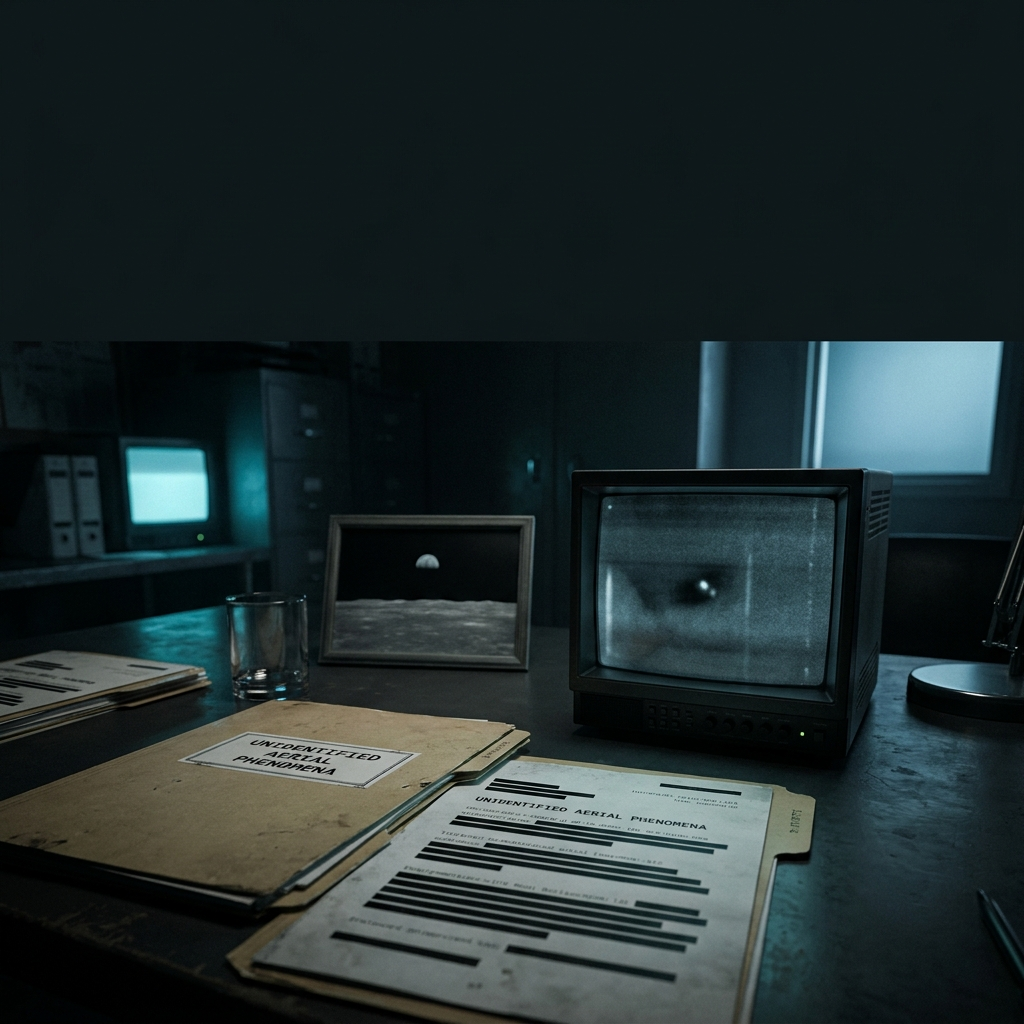
Unknowns in the Machine: UFO Files, AI, and the Politics of Uncertainty The Department of War has launched WAR.GOV/UFO, a new official portal for declassified UAP records under PURSUE — the Presidential Unsealing and Reporting System for UAP Encounters. Release 01, cleared May 8, 2026, lists 161 official files across PDFs, videos, and images from the Department of War, FBI, NASA, and State Department. David Carver is joined by James Okafor, Marcus Chen, and Stan Rogers to unpack what the release actually says — and what it does not. This is not an “aliens confirmed” episode. It is a story about unresolved evidence, national security, redactions, public trust, ambiguous sensor data, and how AI can help analyze enormous archives without turning uncertainty into proof. Sources: Department of War WAR.GOV/UFO PURSUE portal, Department of War May 8 2026 press release, AARO UAP Records, official Release 01 dataset summary, NASA materials included in Release 01, NBC News.
Listen now
Unknowns in the Machine: UFO Files, AI, and the Politics of Uncertainty
Show notes
What this episode covers
- Release 01 is treated as an official archive of unresolved cases, not proof of extraterrestrial visitation.
- The panel separates witness reports, sensor imagery, redactions, and analytical conclusions.
- Marcus frames AI as a triage tool for enormous archives — useful for clustering, dangerous when it turns anomaly detection into proof.
- The companion documentary cut uses official UAP imagery, documents, thumbnails, and restrained generated cards.
Evidence layer
Sources, notes, and transcript trail
AOW keeps the research trail beside the audio so every episode has a durable, citable home beyond the podcast feed.
Research digest
- PURSUE is framed as a rolling interagency declassification effort, not a one-time disclosure.
- The official portal listed 161 Release 01 files as of May 8, across PDFs, videos, and images.
- Unresolved means no definitive determination, often because of insufficient data; it does not mean alien origin.
- AI can help triage records and sensor data but cannot turn ambiguous inputs into proof.
Sources
Attribution trail
- OfficialOpen source
WAR.GOV/UFO PURSUE portal
Department of War
- OfficialOpen source
Department of War May 8 UAP release
Department of War
- OfficialOpen source
AARO UAP Records
All-domain Anomaly Resolution Office
- OfficialOpen source
Release 01 CSV dataset
Department of War
- ReportingOpen source
NBC coverage of Pentagon UAP drop
NBC News
- mediaOpen source
Companion documentary cut
The Synthetic Lens
Transcript
Readable archive
Read transcript
DAVID: The government has opened a new UFO archive. Not a rumor. Not a leak. Not a congressional whisper passed through three podcasts and a grainy screenshot. An official portal, on a dot gov domain, with a name built for history: the Presidential Unsealing and Reporting System for UAP Encounters. PURSUE.
DAVID: It arrived on May eighth, two thousand twenty-six, with Release Zero One marked, cleared for release. One hundred sixty-one files listed on the official portal. Videos. Images. PDFs. FBI records. NASA materials. Department of War reports. State Department cables. Cases from the Moon, low Earth orbit, the western United States, the Arabian Gulf, Syria, Iraq, Greece, Japan, Africa, and more.
DAVID: So let us say the important thing first. This is real. The files are real. The portal is official. The mystery is real too.
DAVID: But unresolved does not mean extraterrestrial. It means the government says it cannot make a definitive determination, often because the data is incomplete.
DAVID: Tonight: the UFO drop, the politics of uncertainty, and what happens when a state finally says, in public, we do not know.
DAVID: Good evening. This is The Synthetic Lens. I'm David Carver. With me tonight: James Okafor on security and conflict, Marcus Chen on technology and sensor data, and Stan Rogers on American politics and culture.
DAVID: James, start us with the official action. What happened today?
JAMES: The Department of War launched WAR dot GOV slash UFO, a dedicated portal for declassified unidentified anomalous phenomena records. It is being run under PURSUE, the Presidential Unsealing and Reporting System for UAP Encounters. According to the portal, this follows a February nineteenth directive from President Donald Trump ordering the Secretary of War and other departments and agencies to identify and release government files related to alien and extraterrestrial life, UAP, UFOs, and related information.
DAVID: And the Department of War is not presenting this as a one-day document dump.
JAMES: Correct. The official language says the Department of War, with support from the Office of the Director of National Intelligence, is overseeing a government-wide effort to find, review, identify, declassify, and publicly release unresolved UAP-related records and historical documents. The portal says this requires coordination across dozens of agencies and review of tens of millions of records, many of them paper-only, spanning decades. Releases are supposed to come on a rolling basis, with tranches posted every few weeks.
DAVID: So Release Zero One is the beginning of a process.
JAMES: That is the claim. The first tranche is listed as one hundred sixty-one files on the official portal as of May eighth. The dataset summary shows one hundred nineteen PDFs, twenty-eight videos, and fourteen images. By agency, the largest share is Department of War, followed by FBI, NASA, and the Department of State.
DAVID: The phrase on the page that matters most may be “unresolved cases.”
JAMES: Absolutely. The portal says these materials are unresolved cases, meaning the government is unable to make a definitive determination on the nature of the observed phenomena. It explicitly says that can happen for a variety of reasons, including lack of sufficient data. That is the caveat. This is not an official finding of extraterrestrial visitation. It is an official archive of things the government says it has not resolved.
DAVID: There is also a statement from Secretary of War Pete Hegseth. The quote is worth hearing because it captures the politics of the release. He says: “The Department of War is in lockstep with President Trump to bring unprecedented transparency regarding our government’s understanding of Unidentified Anomalous Phenomena. These files, hidden behind classifications, have long fueled justified speculation — and it’s time the American people see it for themselves. This release of declassified documents demonstrates the Trump Administration’s earnest commitment to unprecedented transparency.”
STAN: That quote is doing a lot of work.
DAVID: Stan, come in there.
STAN: It is transparency language, campaign language, and culture-war language all at once. “Hidden behind classifications.” “Justified speculation.” “The American people see it for themselves.” That is not just bureaucracy opening a filing cabinet. That is a political actor saying, the government kept something from you, and we are the ones opening the door.
DAVID: Which is powerful, whether or not the files prove anything extraordinary.
STAN: Exactly. UFOs are not just a science story in America. They are a trust story. They sit at the intersection of national security secrecy, pop culture, Cold War anxiety, distrust of institutions, and the very human feeling that official explanations are often incomplete. When a government says, here are the unresolved files, the public does not just read the documents. It reads the gesture.
DAVID: The gesture being: we are letting you look.
STAN: Yes. And that gesture creates two reactions at the same time. One group says, finally. Another says, why now? And a third group, because this is America and we always have a third group, immediately starts counting redactions like they are tea leaves.
DAVID: The redactions are real, though.
STAN: They are. But redaction does not automatically mean conspiracy. It can mean witness identities, facility locations, sensitive military sites, sensor capabilities, sources and methods. The trouble is that secrecy creates a narrative vacuum. If you black out enough lines, people will write their own story in the blank space.
DAVID: Marcus, let's talk about what is actually in the files. Give us the evidence layer, not the mythology layer.
MARCUS: The first tranche is uneven by design. It includes historical records, modern military sensor clips, FBI interviews, NASA material, and State Department cables. Some entries are just documents. Some are short infrared videos. Some are archival space imagery with highlighted areas of interest.
DAVID: Examples.
MARCUS: One NASA item is the Gemini Seven transcript from nineteen sixty-five. Astronaut Frank Borman reports a “bogey,” and the transcript also describes a debris field with many particles. There is a paired audio excerpt. Another set involves Apollo Eleven, Apollo Twelve, and Apollo Seventeen materials: astronauts seeing flashes, lights, or objects, and archival lunar photos with highlighted anomalies. The Apollo Seventeen image entry says there are three dots in a triangular formation in the lunar sky, visible upon magnification, and that there is no consensus about the nature of the anomaly. It also says preliminary government analysis suggests the image feature is potentially the result of a physical object in the scene, with further NASA and Department of War analysis to be released when completed.
DAVID: That sounds made for headlines.
MARCUS: It does. But the scientific posture has to be careful. A dot in a historical image is not an alien craft. It may be a physical object, an imaging artifact, debris, reflection, processing effect, or something else. The important part is that the government is saying it is still looking, not that it has reached the conclusion the internet wants.
DAVID: What about modern military cases?
MARCUS: There are multiple Department of War and AARO unresolved UAP reports from infrared sensors aboard U.S. military platforms. Middle East, Iraq, Syria, United Arab Emirates, Greece, the Gulf of Oman, the East China Sea, Japan, Indo-Pacific Command. One INDOPACOM video from twenty twenty-four is described as nine seconds of infrared footage showing an area of contrast resembling a football-shaped body with three radial projections. Another Japan-related item from twenty twenty-three tracks three distinct areas of contrast maintaining position relative to one another.
DAVID: That phrase, “area of contrast,” is doing scientific work.
MARCUS: It is avoiding overclaiming. Sensor footage does not show reality directly. It shows a measurement translated into an image. Infrared sensors capture heat contrast, affected by angle, range, atmospheric conditions, calibration, platform motion, compression, and operator context. A blob in an infrared frame can be many things before it is a mystery from beyond Earth.
DAVID: The files themselves include caveats.
MARCUS: Repeatedly. Several video descriptions say they are provided for informational purposes only and should not be interpreted as analytical judgment, investigative conclusion, or factual determination. That sentence should be printed across the internet tonight.
STAN: It will not be.
MARCUS: No, it absolutely will not be.
DAVID: James, where does national security fit if we are not doing aliens-confirmed television?
JAMES: It fits very comfortably. UAP is a national-security issue even if every single case eventually turns out to be mundane. Unknown objects or sensor tracks near military facilities, ships, aircraft, test ranges, or conflict zones can represent drones, balloons, adversary surveillance, experimental platforms, sensor errors, misidentified aircraft, satellites, or aviation hazards. All of those matter.
DAVID: One of the FBI entries in the summary involves a senior intelligence official.
JAMES: Yes. The dataset summary describes an FBI three-zero-two interview with a senior U.S. intelligence official regarding a first-hand UAP encounter at a U.S. military facility. The account includes a “super-hot” orb hovering over the ground, a helicopter pursuit, and a swarm of lights. That is striking language. But it is still an interview record. It is human testimony, filtered through law-enforcement documentation, with redactions and limited technical corroboration in the public summary.
DAVID: So we should neither dismiss it nor inflate it.
JAMES: Exactly. Treat it as a serious report, not a final answer. In military and intelligence contexts, unexplained observations deserve investigation because the risk categories are practical. Is this an adversary system? A drone swarm? A sensor anomaly? A classified friendly platform? A safety issue? A misperception under stress? You investigate before you narrate.
DAVID: There is also a western United States event summary from twenty twenty-three.
JAMES: That one involves seven U.S. persons employed by the federal government reporting several experiences over two days: orbs launching other orbs, a large stationary glowing orb, pursuit of a phenomenon near the ground, and a large seemingly transparent object compared to a translucent kite. But the summary also notes no technical data directly associated with the report. That is the tension. Multiple witnesses can make a case important. Lack of technical data makes it hard to resolve.
DAVID: Marcus, this is where The Synthetic Lens has to turn toward AI. We now have an official rolling archive, tens of millions of records potentially under review, and a public hungry for pattern detection. What can AI do here, and what can it break?
MARCUS: AI can help with triage. It can cluster reports by location, sensor type, language, date, platform, and visual features. It can extract metadata from old PDFs, summarize witness statements, identify duplicate cases, compare infrared clips, and flag cases with richer evidence. If PURSUE really involves tens of millions of records, machine assistance is not optional. Humans cannot manually read their way through that at speed.
DAVID: But.
MARCUS: But anomaly detection is not truth detection. AI systems are very good at finding patterns, including patterns that are not meaningful. If you train a model on ambiguous reports, inconsistent metadata, redacted documents, and low-quality imagery, it may produce beautiful taxonomies of uncertainty. That can look like understanding while mostly being organization.
DAVID: A filing cabinet with vibes.
MARCUS: More or less. And worse, AI can laundering speculation into confidence. If a model says “object class resembles X,” people may quote that as a finding. But the model may only be matching visual texture, not resolving range, speed, identity, or physical behavior. The hardest UAP questions are often not “what does this look like?” They are “where was the sensor, what was its field of view, what was the range, what else was in the sky, what were the platform dynamics, and what metadata is missing?”
DAVID: Which is why AARO's previous public materials matter.
MARCUS: Yes. AARO has already published work on satellite flaring, forced perspective, parallax, materials analysis, and limitations in narrative data. Those are not buzzkill explanations. They are the scientific baseline. If a moving sensor films a distant object without range data, apparent speed can be deceptive. If Starlink satellites flare in the sun, they can appear strange. If a witness has only a narrative description, you have data, but not necessarily enough data to calculate a trajectory.
DAVID: Stan, why does the public so often experience that caution as a cover-up?
STAN: Because caution sounds like evasion when trust is already broken. If you tell people, “This remains unresolved due to insufficient data,” many hear, “We know more than we're saying.” And sometimes governments do know more than they are saying. Classification is real. Institutional self-protection is real. The history of secrecy is real. So the skeptical public is not crazy to ask hard questions.
DAVID: But there is a difference between asking hard questions and deciding the answer in advance.
STAN: There is. The cultural problem is that UFO discourse often turns uncertainty into certainty in both directions. The believer says, unresolved means extraterrestrial. The debunker says, unresolved means nothing. The honest answer is less satisfying: unresolved means unresolved. It deserves more data, better tools, and less theater.
DAVID: This release seems designed to invite private-sector analysis.
JAMES: The portal explicitly welcomes private-sector analysis, information, and expertise. That is unusual and important. But it also creates a management problem. Once the files are public, thousands of people will annotate, enhance, upscale, classify, and speculate. Some of that work will be useful. Some will be nonsense. Some will be nonsense with excellent production values.
MARCUS: Upscaling is a perfect example. AI-enhancing a blurry UAP image may make it look clearer, but the added detail can be invented. If a model hallucinates edges or shapes, it may create the very artifact people then analyze. For UAP imagery, provenance matters. Raw file, chain of custody, sensor parameters, and original resolution matter more than a dramatic sharpened frame.
DAVID: So an AI era UAP archive is also an AI literacy test.
MARCUS: Completely. Can the public distinguish evidence from enhancement? Original from derivative? Metadata from interpretation? The files are not just about objects in the sky. They are about how societies reason when images, sensors, algorithms, and politics all collide.
DAVID: James, what should we watch in future releases?
JAMES: First, whether later tranches include richer technical packages: full-motion video with metadata, radar tracks, platform data, weather, exact timestamps, and resolved-case comparisons. Second, whether agencies release methodology, not just artifacts. Third, whether DOW and AARO explain why particular cases remain unresolved. “We do not know” is more useful when paired with “here is what data is missing.”
DAVID: And from a security standpoint?
JAMES: Watch the geography. Reports near test ranges, naval chokepoints, overseas bases, and conflict zones carry different implications than historical civilian sightings. Also watch redaction patterns. Some redactions will be ordinary protection of sensitive information. But if too much context is removed, the public will have images without the facts needed to evaluate them.
STAN: Politically, watch Congress. A rolling release every few weeks means recurring oxygen. Hearings, demands for more files, accusations of withholding, counterclaims of overhyping. UFO transparency can become a standing political theater because it rewards suspicion without requiring resolution.
DAVID: That sounds bleak.
STAN: It is not only bleak. Transparency is good. Opening archives is good. Letting independent researchers look is good. But transparency is not the same as explanation. The files can be public and still not tell a clean story.
DAVID: That may be the core of it. The government has released a door, not an answer.
MARCUS: And maybe that is healthier than pretending a door is an answer.
DAVID: Before we close, I want to reset the facts cleanly. The May eighth release is official. The portal is WAR dot GOV slash UFO. It is called PURSUE, the Presidential Unsealing and Reporting System for UAP Encounters. Release Zero One is listed as cleared for release on May eighth, two thousand twenty-six. The official portal lists one hundred sixty-one files: PDFs, videos, and images from the Department of War, FBI, NASA, and State Department. The Department of War says this is a rolling, interagency declassification effort involving dozens of agencies and tens of millions of records, with future tranches expected every few weeks.
DAVID: The archive is framed as unresolved cases. The government says unresolved means it cannot make a definitive determination, often because of insufficient data. That does not equal extraterrestrial. It also does not equal irrelevant. Unknown airspace events can matter for aviation safety, intelligence, drones, adversary platforms, sensor reliability, and public trust.
DAVID: Some files are historically fascinating: Gemini Seven, Apollo transcripts, lunar images, State Department cables. Some are operationally serious: infrared clips from military platforms and reports near conflict zones or U.S. facilities. Some are probably mundane. Some may remain genuinely strange. But the responsible sentence tonight is not “aliens confirmed.” It is: the official record of uncertainty just got bigger.
DAVID: The deeper story is what we do with that uncertainty. A democracy has to be able to hear “we do not know” without instantly converting it into “they are lying” or “it must be aliens.” A scientific culture has to be able to investigate anomalies without making mystery a product. And an AI culture has to learn that pattern recognition is not proof.
DAVID: The sky has always been a screen for human fear, hope, power, and imagination. Now it is also a data problem, a national-security problem, and a trust problem. Release Zero One does not solve that. It names it.
DAVID: Sources for this episode include the Department of War PURSUE portal at WAR dot GOV slash UFO, the Department of War May eighth press release, AARO public UAP records, NASA materials included in Release Zero One, the official Release Zero One dataset summary, and NBC News reporting on the declassification drop.
DAVID: This has been The Synthetic Lens. I'm David Carver. Keep looking up. More importantly, keep asking what the evidence can actually bear.
Related
Continue the thread

EP103 / May 8, 2026
Claude Stops Coding Alone: Anthropic’s Agent Operating Layer
A briefing on Anthropic’s shift from coding assistant to managed agent operating layer.