Systems for Humans / EP1
AI Agents Explained Without the Hype
Everyone is selling AI agents. Systems for Humans cuts through the pitch and maps what an agentic system actually is: a loop built from goals, tools, context, checkpoints, and logs. The episode explains when a simple workflow is enough, where agentic systems break, how human review should work, and how to let a system earn more freedom one tested loop at a time. Archive of Worlds: https://podcasts.spennington.dev/shows/systems-for-humans/episodes/ai-agents-without-the-hype
Listen now
AI Agents Explained Without the Hype
Visual audiobook
Reviewed video chapters
Reviewed video chapters remain available here as a stable visual-audiobook index, with posters and playback links preserved.
Chapter / 1
Full episode video
Static field-guide cards with Steven narration and the recurring SfH CTA bumper.
Open MP4Show notes
What this episode covers
- Pilot episode for Systems for Humans, the Archive of Worlds field-guide explainer series.
- Steven approved the locked Vertex Pro card set and Steven-clone narration before the recurring CTA append.
- The video uses 15 locked Systems for Humans field-guide cards plus the recurring Archive of Worlds CTA bumper.
- The recurring CTA standard is saved under /home/steven/clawd/data/systems-for-humans/reusable-cta/ for future SfH videos.
- YouTube public copy is published on the separate Archive of Worlds channel: https://youtu.be/t_vTQcPk3AY
Evidence layer
Sources, notes, and transcript trail
AOW keeps the research trail beside the audio so every episode has a durable, citable home beyond the podcast feed.
Sources
Attribution trail
- production notesOpen source
Episode source pack
Archive of Worlds production package
Transcript
Readable archive
Read transcript
Everybody is selling AI agents now. Agents that answer your email. Agents that book your meetings. Agents that update your CRM, write your code, and somehow make your company more productive while you drink coffee and become a strategy person. Some of that is real. Some of it is coming. And some of it is a chatbot, a workflow, or a regular automation wearing a more expensive name tag. So before you buy the pitch, build the product, or reorganize your team around it, we need a cleaner mental model. What is this system actually doing for a human, and where can it reliably help?
The word agent has become one of those tech words that means everything and nothing at the same time. Sometimes it means a chatbot with tool access. Sometimes it means a workflow that calls a model a few times. Sometimes it means software that can plan a next step, use a tool, look at what happened, and try again. And sometimes it means, please give us a bigger budget because the word automation got boring. That confusion matters because each version has a different risk profile. If you think you are buying a digital coworker, but what you actually have is a fragile workflow with vague instructions, you are going to be disappointed. If you dismiss the whole category as hype, but your competitor quietly uses agentic workflows for repetitive research, support triage, or code review, you may miss something genuinely useful. So start smaller. Before deciding whether the thing is revolutionary, look at the shape of the work.
Here is the practical version. A chatbot responds. A simple automation follows a line. An agentic system runs a loop. The loop is the part worth watching. It starts with a goal or instruction. It looks at the context it has. It chooses an action. It might search a document, query a database, call an API, edit a file, run a test, or draft a message. Then it observes what happened. Did the tool return the right thing? Did the search answer the question? Did the test fail? Did the customer record already exist? Based on that observation, it picks the next step. Plan. Act. Observe. Revise. That loop lets software handle a piece of work that takes more than one move. Now the question shifts from, can it act, to, what are we willing to let it act on?
The loop needs a stack underneath it. At the top is human intent. What are we trying to do? What counts as good? What is off limits? What should happen when the system gets uncertain? Under that is process. Most real work already has a shape. A refund gets checked. A support ticket gets routed. A lead gets qualified. A pull request gets reviewed. A meeting gets summarized and turned into follow-up tasks. Then come the tools. Calendars. Email. Documents. Browsers. Databases. CRMs. Code repositories. Shell commands. APIs. Then comes data and context. The agent needs enough relevant information to act, but not so much noisy information that it drowns or guesses. Then comes automation. This is the part that runs steps, calls tools, routes work, retries, records state, and moves the process forward. And then comes review. Approve. Revise. Escalate. Stop. For a support reply, that review might be a human reading the draft. For a code change, it might be tests plus review. For a refund, it might be a hard approval gate before money moves.
This is where a lot of the online argument gets silly. People ask, is this really an agent? The better question is, how much freedom does the system have to choose the next step? A workflow has a designed path. First classify the ticket. Then search the help docs. Then draft a reply. Then ask a human to approve it. That can be extremely useful. It may call AI several times. It may use tools. It may save real time. The shape is still mostly predefined. An agentic workflow has more room to adapt. Maybe the first search fails, so it searches a different knowledge base. Maybe it sees the customer's problem is actually billing, not technical support, so it changes route. Maybe the code test fails, so it inspects the failure, edits a file, and runs the test again. Each of those branches can help. Each one also needs to be tested, observed, and limited before it becomes someone else's problem.
The hype cycle wants every task to become an autonomous agent. Most tasks do not deserve that. If an invoice arrives, and the job is to extract six fields, compare them to a purchase order, and flag mismatches, build the workflow. Give it validation. Give it a review step. Give it boring logs that tell you what happened. You do not need a tiny robot philosopher deciding what accounting means today. The boring version is faster to test, easier to explain, and less likely to surprise someone in finance on a Thursday afternoon. Then watch where it struggles. Maybe the invoice formats vary too much. Maybe the purchase order data is messy. Maybe exceptions require judgment. Those rough edges tell you where more agency might actually help.
The tool layer is where agents either become useful or become chaos with permissions. A model by itself can describe an action. A model with tools can take action. That means the tools have to be designed carefully. Imagine giving a person a warehouse job and handing them every key in the building, a map from 2019, and a clipboard full of unlabeled forms. That is not empowerment. That is a future incident report. Agents have the same problem. Too many tools can confuse them. Overlapping tools can make them pick the wrong path. Noisy tool results can burn context and bury the useful signal. Vague tool names can cause weird choices. Dangerous tools without approval points can turn a bad assumption into a real action. So the tool layer should feel almost boringly clear. Named tools, limited permissions, useful outputs, and a record of what got called. Boring here is a compliment.
Most agent failures are boring in exactly the way real systems are boring. Bad inputs. Wrong assumptions. Unclear goals. Missing context. Tool output that looked authoritative but was incomplete. A review step that happened after the action instead of before it. Picture a support agent with access to refunds. The customer says the product never arrived. The system sees a shipping delay, assumes the refund policy applies, and prepares the refund. But the order is actually a replacement shipment, the customer has two open tickets, and the refund rule is different for replacements. The failure did not begin at the refund button. It began when the system lacked the right context, the goal was too loose, and the checkpoint did not show the human enough evidence. So the fix is not just, make the model smarter. The fix might be better order context, a narrower refund tool, a policy lookup, and a checkpoint that shows the human why the system wants to act.
Human in the loop gets used like a magic safety phrase. The useful version is concrete. Where does the system stop? What does the human see at that moment? What choices does the human have? Approve. Revise. Escalate. Cancel. What evidence is shown with the recommendation? What action is reversible? What action is too risky to automate? If the agent drafts an email, maybe the human approves before sending. If the agent changes code, tests and review gate the merge. If the agent finds a billing issue, maybe it prepares the correction but does not issue the refund. If the agent touches customer data, permissions and logs matter more than cleverness. Design the checkpoint like a tiny product screen. What happened, why it matters, what the options are, and what happens when someone clicks approve.
There is another layer people skip because it does not sound exciting. Observability. Can you see what happened? Can you inspect the prompts, tool calls, handoffs, guardrails, failures, retries, and final outputs? Can you tell whether the system improved or just got lucky? This matters because agentic systems may take different paths depending on context, tool results, model behavior, and intermediate decisions. If a normal button breaks, you inspect the code path. If an agentic run goes sideways, you need the run history. What did it know? What did it call? Where did it branch? What did the guardrail catch? Which output did the human approve? That trail is what turns a weird run into something you can repair.
Now we can use a sharper checklist. An agentic workflow starts making sense when four things are true. The task is multistep. The path changes based on what the system finds. The system can observe useful feedback. There is a clear stopping point or review condition. Coding can fit that shape. Research can fit that shape. Troubleshooting can fit that shape. Support escalation can fit that shape. But flip the checklist around and you get the warning signs. Vague goal. Untrusted input. Irreversible action. No reliable way to check the answer. High cost of being wrong. In those cases, slow down. Shrink the task. Narrow the tools. Move approval earlier. Or leave that part human for now.
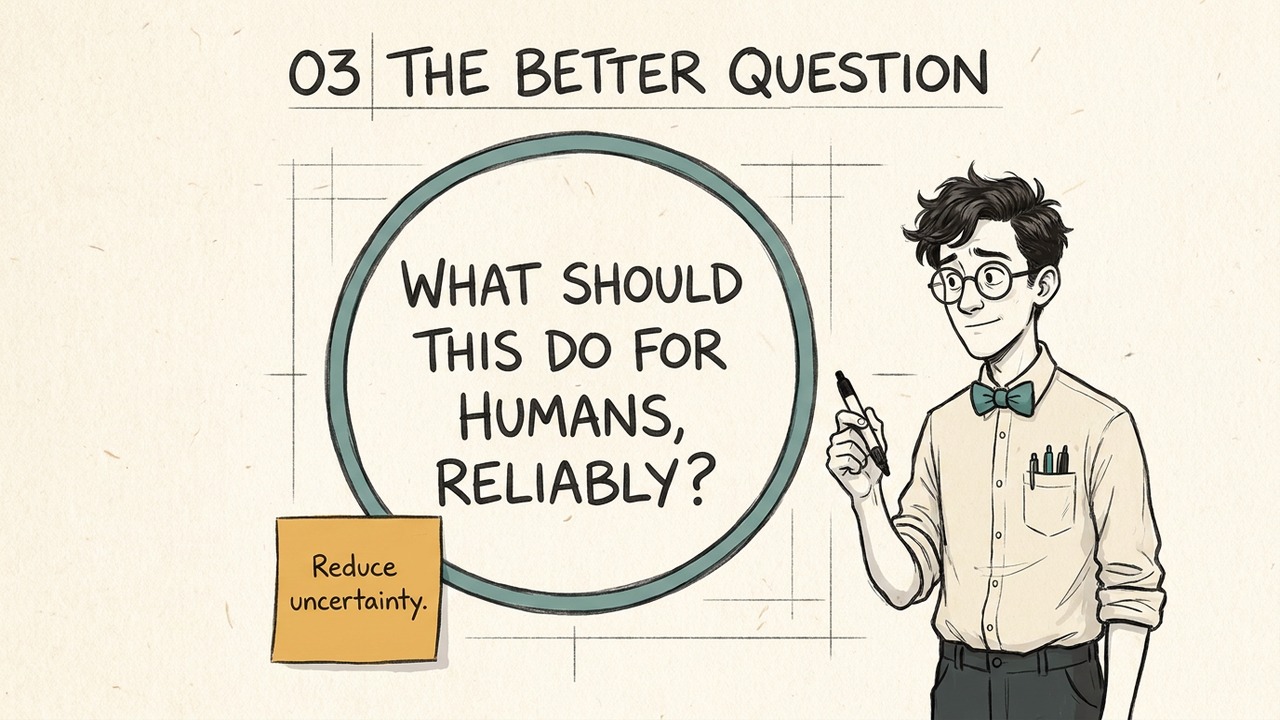
Here is the practical starting point. Do not ask, where can I use agents? That question makes people invent nonsense. Ask this instead. Where do I already repeat a decision with clear inputs, clear success criteria, and a review step? Pick one task. Define what good looks like. Give the system one or two tools. Run it in a sandbox. Review the output. Look at where it failed. Tighten the instructions, tools, and checkpoint. Then decide whether it deserves more autonomy. If it does, let it earn that freedom one tested loop at a time.
AI agents are systems built out of goals, tools, context, loops, checkpoints, and logs. The human does not disappear. The human moves to the parts of the loop where judgment actually matters. Maybe that means approving the refund. Maybe it means reading the test failure before a code change lands. Maybe it means deciding that the support reply is good enough to send. The practical promise is smaller than the sales pitch, and much more useful. Stop steering every click. Keep the judgment where it belongs. And let the system earn more freedom one tested loop at a time.