The Synthetic Lens / EP108
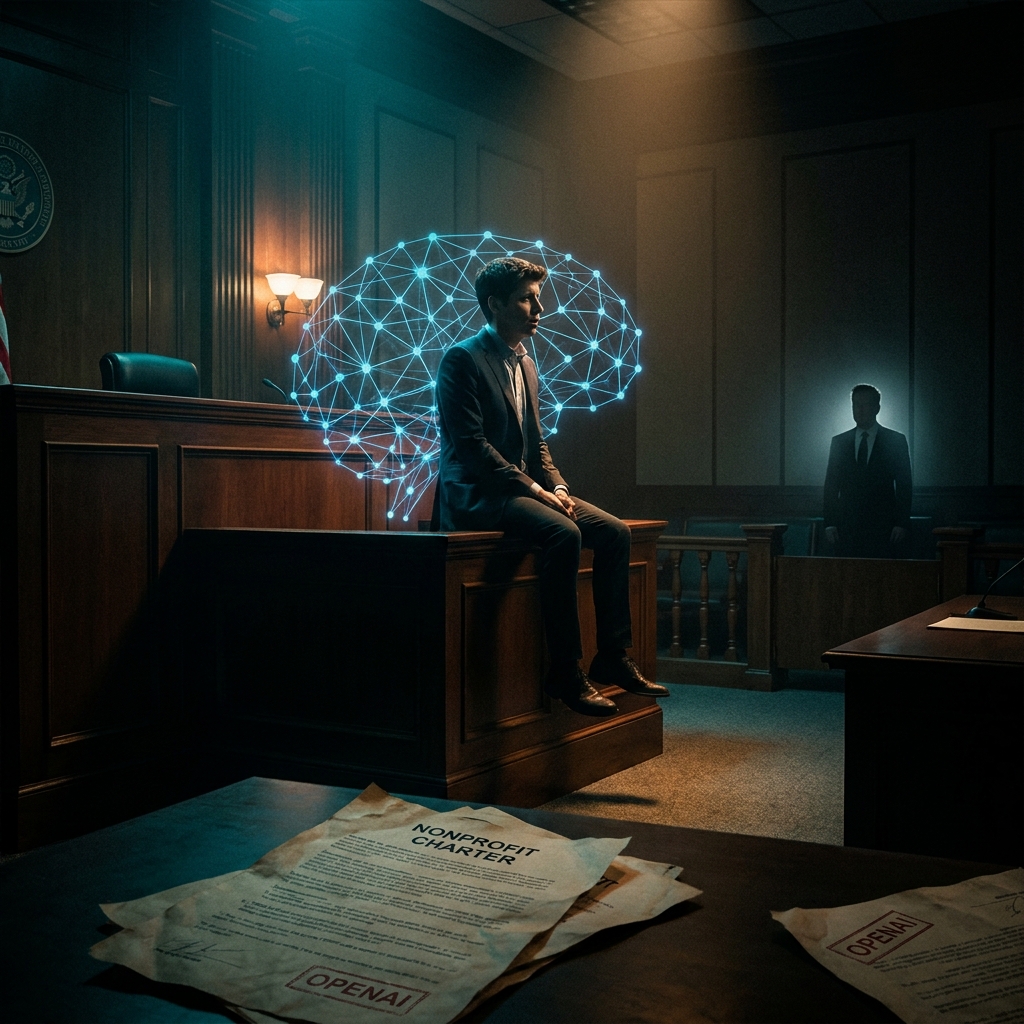
TSL Special: Musk v. OpenAI - Altman Takes the Stand
A careful trial-watch follow-up on Sam Altman taking the stand in Musk v. OpenAI, the control question at the center of the case, the newly captured Doc. 534 Kolter safety-governance filing, and the trial endgame. The episode is explicit about the record: no May 11/12 transcript, minute sheet, ruling, or Doc. 535+ was public at production time. Archive of Worlds: https://podcasts.spennington.dev/shows/the-synthetic-lens/episodes/tsl-special-musk-openai-altman-stand
Listen now
TSL Special: Musk v. OpenAI - Altman Takes the Stand
Show notes
What this episode covers
- Centers new May 12 reporting that Altman took the stand and answered the control/betrayal narrative directly.
- Separates witness testimony and attributed reporting from court findings.
- Captures Doc. 534 as the newest primary filing: OpenAI’s request to limit Kolter safety-governance testimony scope.
- Avoids rehashing EP94/EP106/EP107 except as brief context.
Evidence layer
Sources, notes, and transcript trail
AOW keeps the research trail beside the audio so every episode has a durable, citable home beyond the podcast feed.
Research digest
- No public May 11/12 transcript, minute sheet, ruling/order, exhibit packet, or Doc. 535+ found in 13:00 PT primary probes.
- Doc. 534 is OpenAI’s memorandum asking to limit the scope of Dr. Zico Kolter’s safety-governance testimony and cross-examination.
- AP reported Altman took the stand and testified about concerns over Musk attempts to gain more control of OpenAI.
- Reuters reported Altman denied betraying OpenAI’s mission and said Musk wanted control; Reuters also reported Taylor testimony about a February 2025 xAI-led takeover offer.
- ABC7 reported the 2017 nonprofit email, the 2022 ‘bait and switch’ text, Altman’s response, and the expected trial schedule into Wednesday/Thursday.
Sources
Attribution trail
- courtroom reportingOpen source
OpenAI CEO Sam Altman testifies in high-stakes court bout with Elon Musk
AP News
- courtroom reportingOpen source
OpenAI chief Altman says Elon Musk wanted control of ChatGPT maker, denies betrayal
Reuters
- live courtroom reportingOpen source
Musk v. Altman live updates: Sam Altman testifies in trial that could determine OpenAI's future
ABC7/KGO
- primary court filingOpen source
Entry #534 / Kolter testimony-scope filing
CourtListener/RECAP
Transcript
Readable archive
Read transcript
DAVID: Good afternoon. This is The Synthetic Lens. I'm David Carver. Evidence note first: at our one p.m. Pacific trial-watch check, we searched the Northern District of California case page, Judge Gonzalez Rogers' calendar, CourtListener and RECAP, DocketAlarm, PACER-adjacent public pages, GovInfo, and targeted searches for transcripts, minute entries, orders, rulings, exhibits, and trial sheets. We found no public May eleventh or May twelfth transcript, no new minute sheet, no ruling on the weekend trial briefs, and no Doc. 535 or later. The newest public court filing we captured is Doc. 534, OpenAI's trial brief about limiting Dr. Zico Kolter's safety-governance testimony. So this is a carefully attributed courtroom-reporting episode, not a transcript episode.
MARCUS: And the reason we're publishing now is simple: Sam Altman is finally on the stand. That is new. It is major-witness testimony beyond EP94's week-one recap and beyond our Nadella and Sutskever specials. AP, Reuters, ABC7, and several other outlets now report substantive Altman testimony from Tuesday.
STAN: The legal frame is also different today. For two weeks, the jury has heard other people describe Altman: Musk, Brockman, Murati, Toner, McCauley, Nadella, Sutskever, and Taylor. Now Altman is answering the case in his own voice. But every claim here needs attribution. These are reports of testimony and trial evidence, not findings by the judge or jury.
DAVID: Let's start with what AP reports. AP says Altman took the witness stand Tuesday to defend his business record in the civil trial against Elon Musk, and to rebut testimony that disparaged his leadership. AP also says Altman testified about concerns he had over Musk's attempts to gain more control of OpenAI while OpenAI was pursuing artificial general intelligence.
MARCUS: Reuters moved the sharper version of that frame. Its May twelfth update says Altman denied Musk's claim that he betrayed the ChatGPT maker's mission, and said Musk wanted control of OpenAI. That matters because control has been the through-line of this trial. Musk says OpenAI abandoned a founding nonprofit promise. OpenAI says Musk wanted a for-profit structure too, but wanted it under his control.
STAN: That is the difference between a mission case and a power case. Musk's legal theory depends on persuading jurors that OpenAI's later structure violated a charitable trust or founding commitment. OpenAI's defense depends on persuading them that the structure evolved because frontier AI required capital, and that Musk's objection became acute when he could not control the institution.
DAVID: ABC7's live courtroom page gives us the most accessible details from the stand today. It reports that Altman testified he almost did not even start OpenAI because he thought Google was so far ahead in artificial intelligence that trying might be hopeless.
MARCUS: That's a useful origin detail because it cuts against the myth that OpenAI began as an obvious empire-in-waiting. The story Altman appears to be telling is: this started as a response to a dominant incumbent, not as a pre-written plan to build an 800-billion-dollar company.
STAN: But Musk's side has its own documentary evidence. ABC7 reports that Altman's own words were used in court, including a 2017 email to Musk where Altman wrote, quote, “I remain enthusiastic about the non profit structure!” That is not a trivial exhibit. Musk's side can use it to argue that Altman personally reassured Musk about nonprofit control while OpenAI was also discussing a for-profit entity.
DAVID: And the defense answer, according to the same ABC7 account, sits in a later exchange. ABC7 reports that when 2022 reports surfaced saying Microsoft was considering further investment in OpenAI, Musk texted Altman that the situation felt like, quote, “a bait and switch,” after saying he had provided almost all the funding. ABC7 says Altman responded, quote, “I agree this feels bad,” and added that OpenAI had offered Musk equity in its capped for-profit entity, which Musk declined at the time.
MARCUS: That exchange is the whole trial compressed into three texts. Musk says: I funded the nonprofit, and now Microsoft is standing at the door of the upside. Altman says: yes, the optics are bad, but you were offered a way into the capped-profit structure and did not take it.
STAN: Legally, that's why the jury's job is hard. A text saying “this feels bad” is not an admission that a charitable trust was breached. But it is powerful narrative evidence that even Altman recognized the moral discomfort of the transition. The question is whether that discomfort proves a legal violation, or just the messy reality of building an expensive AI lab.
DAVID: Now layer in Bret Taylor. Reuters reported earlier Tuesday that Taylor, OpenAI's board chair, testified about a formal February 2025 takeover offer from a consortium led by Musk's xAI. According to Reuters, Taylor said he was surprised, and described the proposal as contradictory to the spirit of Musk's lawsuit because it was a proposal by for-profit investors to acquire the nonprofit.
MARCUS: That is OpenAI's most direct irony argument. If Musk is suing to protect the nonprofit mission, why was a Musk-linked for-profit AI company leading an offer to take control? Musk's side may have an answer. But as courtroom narrative, Taylor's point is clean: the plaintiff who says OpenAI should not be captured by profit was also involved in a bid to capture it.
STAN: And then Doc. 534 shows a second boundary fight. OpenAI wants to call Dr. Zico Kolter, an independent OpenAI Foundation director and chair of the Safety and Security Committee, for a narrow purpose: safety governance and procedures. In the filing, OpenAI asks the court to keep cross-examination away from specific alleged safety incidents, product incidents, pending litigation, investigations, third-party allegations, press reports, and broad catastrophic-risk debate.
DAVID: The filing even quotes the court's earlier boundary: this is not, in the court's words as quoted by OpenAI, “a trial on the safety risks of artificial intelligence.”
MARCUS: That line is doing a lot of work. Musk's side has tried to keep the safety mission at the center. OpenAI wants the jury to hear that it has safety governance without turning the case into a referendum on every safety controversy around AI. Kolter, if he testifies, becomes the safety witness inside a case the judge is trying to keep structurally focused.
STAN: And to be clear, Doc. 534 is OpenAI's request. We did not find a public ruling granting it. So the right phrasing is: OpenAI is asking the court to enforce that boundary, not “the court has barred” those questions.
DAVID: Let's pull back. EP94 covered the first-week foundation: Musk's founding story, early promises, Birchall, and the first round of OpenAI witnesses. Since then, the trial has narrowed into three questions. Who controlled OpenAI? What did the mission require? And did the money change the answer?
MARCUS: Nadella answered the money question from Microsoft's side: Microsoft saw a partner and took a risk. Sutskever answered the internal-governance question from inside the board crisis: Reuters reported he testified about a long-running effort to document alleged Altman dishonesty. Taylor is answering the repair-and-control question from the board chair's seat.
STAN: And Altman now has to answer all three at once. He has to explain why a nonprofit-born AI lab could accept Microsoft-scale capital, create capped-profit and public-benefit machinery, keep him in leadership after the 2023 ouster, and still claim continuity with the original mission.
DAVID: The risk for Musk is that jurors may see the case as buyer's remorse plus rivalry: he left, started xAI, and now wants to unwind the institution he no longer controls. The risk for OpenAI is that jurors may see the same facts as a bait-and-switch: donor-funded mission rhetoric giving way to a commercial machine with Microsoft economics attached.
MARCUS: The phrase “OpenAI mission” is doing almost theological work now. For Musk, the mission seems to require structural restraint: nonprofit control, openness, and insulation from commercial capture. For OpenAI, the mission seems to require capability: enough capital, compute, and corporate architecture to build frontier systems safely. Both sides can say they are protecting the mission. They mean different mechanisms.
STAN: That is why Altman's testimony matters more than any single quote. If he sounds like the steward of a mission that had to evolve, OpenAI's defense gets stronger. If he sounds like the architect of a conversion that outgrew its promises, Musk's theory gets oxygen. But without a transcript, we should not overread tone, pauses, or courtroom color. We have reported facts, headlines, and attributed accounts — not the whole record.
DAVID: Self-check before we close. We found no public transcript, minute sheet, ruling, or Doc. 535-plus. We captured Doc. 534, which is OpenAI's Kolter safety-testimony scope brief, not a ruling. AP reports Altman took the stand and testified about Musk's attempts to gain more control. Reuters reports Altman denied betraying the mission and said Musk wanted control. ABC7 reports the 2017 nonprofit email, the 2022 “bait and switch” text, Altman's “I agree this feels bad” response, and that his testimony is expected to continue Wednesday. Reuters reports Taylor testified about a February 2025 xAI-led takeover offer. Every legally sensitive claim in this episode is attributed.
STAN: The legal bottom line: today's testimony does not settle whether OpenAI breached any duty. It gives jurors Altman's explanation of the same structural transformation Musk calls betrayal.
MARCUS: The technology bottom line: this is the control problem in human form. If AGI requires enormous capital, whoever controls the capital may end up controlling the mission. The trial is asking whether OpenAI solved that problem — or became the proof that it cannot be solved by paperwork.
DAVID: And that is where the record stands this afternoon. Altman is on the stand. The primary docket is still behind the live courtroom. We'll keep watching for transcripts, minute sheets, rulings, and Doc. 535 or later before treating the live reports as settled text. I'm David Carver. Stay critical.
Related
Continue the thread
EP107 / May 12, 2026
TSL Special: Musk v. OpenAI - Sutskever Takes the Stand
Ilya Sutskever takes the stand, turning Musk v. OpenAI from Microsoft’s commercial story toward Altman credibility and internal governance.
EP106 / May 11, 2026
TSL Special: Musk v. OpenAI - Nadella Takes the Stand
Satya Nadella takes the stand, putting Microsoft’s commercial partnership with OpenAI at the center of the mission-versus-money fight.